

What Are Robotic Process Automation Technologies in Manufacturing
2026. 08. 11

Robotic process automation in manufacturing is a physical system that uses programmable robots, sensors, software, tooling, and connected equipment to perform production tasks. In this article, this term refers to automation on the factory floor, rather than the process of entering data, moving files, or automating office workflows.
This distinction matters because factory automation involves physical movement, machine interaction, product quality, worker safety, cycle time, and plant layout. While software automation can update an invoice without directly handling a product, on the other hand, a manufacturing robot can pick a component, insert it into an assembly, inspect the result, and place the finished part on a conveyor.
The market is already operating at a large scale. The World Robotics 2025 report found that 542,000 industrial robots were installed during 2024. Annual installations also remained above 500,000 units for the fourth consecutive year, while the United States installed 34,200 units in 2024.
What Are Robotic Process Automation Technologies in Manufacturing Operations?
A complete robotic automation system typically combines a robot arm, end-of-arm tooling, sensors, vision, safety devices, controls, and software. It may also connect with conveyors, CNC machines, presses, inspection equipment, warehouse systems, or production data platforms.
Traditional industrial robots often work inside guarded cells. Collaborative industrial robots, commonly called cobots, are designed for applications where people and robots may work in closer proximity after a proper risk assessment. Some systems also place an arm on a mobile base, creating a collaborative mobile robot that can transport parts and complete tasks at different stations.
The right design depends on the process. No single robot type fits every plant, product, or production goal.
What Are the Uses of Cobots in Manufacturing?
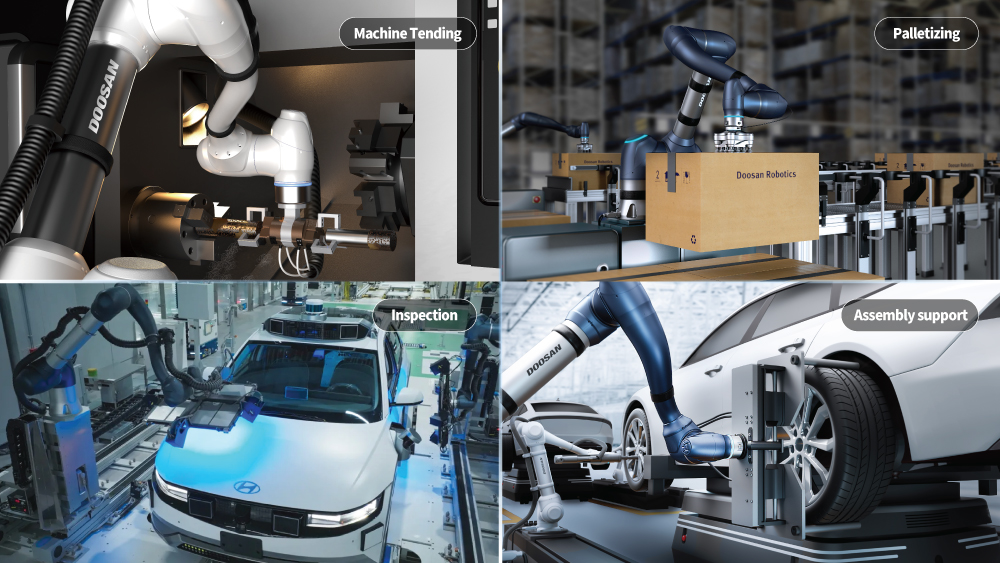
Cobots in manufacturing are often used for repetitive, physically demanding, or precision-focused work. Common collaborative robot applications include machine tending, screwdriving, pick and place, inspection, sanding, dispensing, and palletizing.
Electronics and Assembly
In electronics and semiconductor manufacturing, an assembly cobot can handle delicate components, support precise insertion, or move parts between process steps. These applications benefit from repeatability while still allowing employees to manage exceptions, quality decisions, and changeovers.
Material Handling
Material handling is another strong starting point. A cobot can load and unload equipment, transfer workpieces, sort products, or feed a packaging line. At the end of production, a robotic palletizing system can stack boxes or containers in programmed patterns while reducing repetitive lifting.
What Are the Advantages of Cobots?
The advantages of cobots depend on the task and the quality of the deployment. A well-selected cobot solution can support several operating goals.
Consistency comes from repeating programmed motions with controlled positioning and force. Throughput can improve when the robot keeps a stable cycle and workers are free to address tasks that require greater judgment. Flexibility comes from the ability to reprogram a cobot, change tooling, or move it to another suitable process.
Cobots can also support safety and labor needs by taking on repetitive lifting, awkward reaches, and exposure to unpleasant processes. They do not remove the need for risk assessment, guarding decisions, training, maintenance procedures, or safe tooling. OSHA’s robotics overview explains that robots are widely used for hazardous and highly repetitive work. It also warns that many accidents happen during setup, testing, maintenance, and adjustment.
Scalability is another benefit. A manufacturer can begin with one cell, document the results, and expand the approach to similar processes. This creates a measured path toward automation instead of requiring a plant wide conversion at the start.
What Industries Use Cobots the Most?
Cobots appear across automotive, electronics, semiconductor, metalworking, logistics, food production, packaging, and general manufacturing. The strongest fit is usually determined by the task rather than the industry name.
Electronics plants may prioritize precision assembly and parts handling. Metalworking facilities may focus on machine tending, welding, or surface finishing. Warehouses and production sites may use robots for sorting, packaging, palletizing, and movement between work areas.
When comparing the best collaborative robots or collaborative robot companies, decision makers should look beyond a broad industry label. Payload, reach, repeatability, speed, tooling, environmental conditions, integration requirements, and available support all affect the result.
How Do You Choose a Good First Automation Project?
A strong first project usually has a clear problem, stable inputs, measurable output, and limited process variation. Use these practical criteria:
1. The task repeats frequently and follows a defined sequence.
2. Labor is difficult to assign, or the work causes fatigue.
3. Quality or cycle time varies measurably.
4. Parts arrive in predictable positions or can be presented consistently.
5. The process has enough volume to justify integration, training, and support.
6. Success can be measured through throughput, defects, downtime, labor use, or ergonomic improvement.
Avoid choosing a process only because it looks impressive in a demonstration. NIST’s research into the performance of collaborative robot systems emphasizes test
methods and metrics for evaluating whether human and robot teams complete tasks safely, correctly, and efficiently. That approach helps manufacturers judge the
complete process rather than the robot alone.
When Can Turnkey Automation Reduce Deployment Complexity?
A robot purchase is only one part of implementation. Manufacturers may also need end-of-arm tooling, fixtures, vision, safety components, programming, installation, operator training, and ongoing service.
Turnkey cobot solutions can reduce complexity when a manufacturer wants a coordinated system for a defined application such as palletizing, machine tending, welding, or surface finishing. Turnkey support can also help teams identify integration risks earlier, establish performance targets, and move from planning to production with fewer disconnected vendors.
The best first step is a process review that matches the application, product flow, workforce needs, and expected return. Manufacturers should automate where the business case is clear and keep people at the center of tasks that rely on judgment, adaptability, and problem-solving.
Contact us today to discuss which physical automation opportunity could deliver practical value in your manufacturing operation.
