

High-Tech AI Robots in Automation | Doosan Robotics
2026. 08. 25
High-Tech AI Robots: How AI Is Changing Collaborative Automation
High-tech AI robots are expanding what collaborative automation can handle in manufacturing and logistics. Here, “high tech” does not mean a robot that thinks like a person. It means a robotic system that uses artificial intelligence to improve perception, motion planning, task selection, and response to changing conditions.
AI is a capability layer within an automation system. It can help robotic arms interpret sensor data, recognize objects, choose among approved actions, or adjust a planned motion. It does not replace sound application engineering, reliable tooling, safe system design, or clear performance goals.
According to the International Federation of Robotics’ preliminary 2025 results, industrial robot installations in the United States rose 11 percent to 38,000 units in 2025. Global operational stock reached 4,663,773 robots, an increase of 8.9 percent. These figures show the scale of automated factory robots as AI-powered robotics develops.
What Is a High-Tech AI Robot?
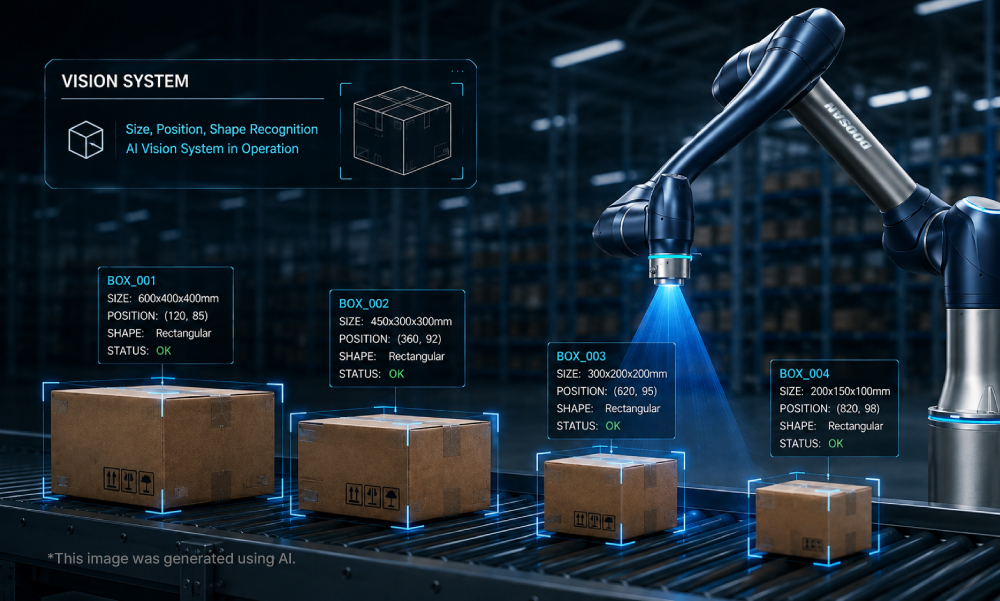
A high-tech AI robot combines physical robotics with software models that interpret data or select actions within defined limits. It may include a robot arm, cameras, force sensors, grippers, safety equipment, controls, and AI software.
You still need to define what the robot should handle, where objects will appear, what conditions are acceptable, and how the system should respond outside its operating range.
A material handling robot, for example, may use vision to identify boxes of different sizes. Motion planning software can calculate a suitable path while respecting known obstacles and system limits. The result is greater flexibility within a controlled process, rather than unlimited independence.
What Is the Difference Between a Traditional Robot and an AI-Powered Robot?
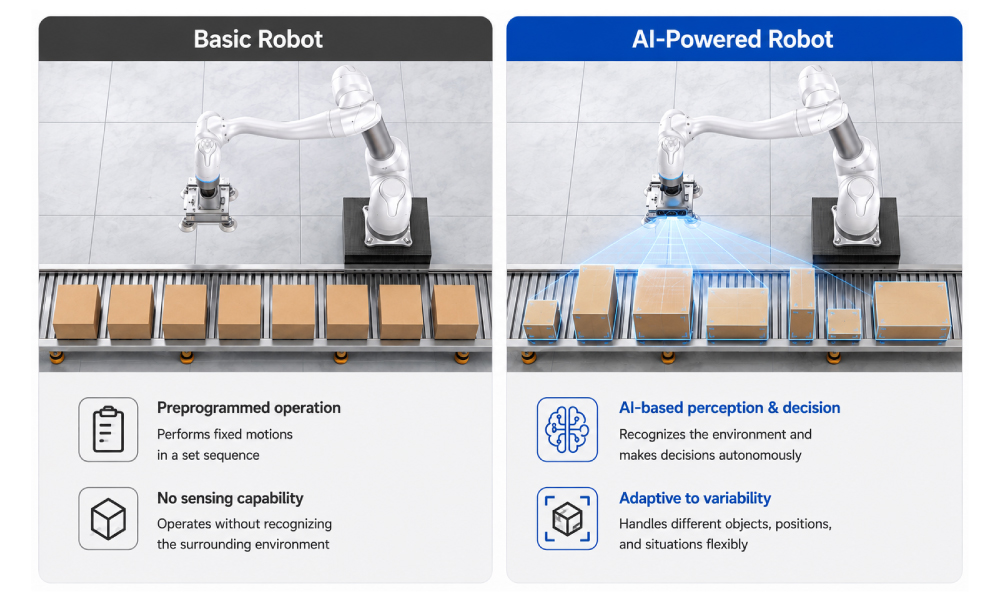
Traditional programmed automation follows predetermined instructions. A robot may move to a position, close a gripper, lift a part, and repeat the sequence. This works well when products, positions, timing, and surrounding equipment remain consistent.
AI cobots can handle greater variation. Vision and perception tools enable the robot to locate objects and adapt its motion independently, rather than being confined to predefined positions. AI can also support classification, defect recognition, path optimization, or selecting from approved workflows.
Traditional robotic automation solutions can also use sensors, vision, and conditional programming. AI adds tools for interpreting more complex inputs. You should evaluate the specific capability and measured performance instead of treating “AI” as a complete system description.
How Is AI Used in Collaborative Robots?
AI in manufacturing is most valuable when it solves a defined operating problem. Practical uses include:
1. Improved perception to identify objects, orientation, or surface conditions.
2. Smarter motion planning around known obstacles.
3. Adaptive workflows that select among validated actions.
4. Data-informed automation that reveals faults or process improvement opportunities.
5. Flexible execution across a controlled range of parts or package sizes.
Embodied Reasoning AI can help a robotic system evaluate package conditions, interpret visual information, and select an appropriate handling action within defined operating limits. In palletizing applications, this added perception can support more flexible responses to variation without implying human-like intelligence or fully autonomous decision-making.
Can AI Robots Improve Manufacturing Flexibility?
AI robots can improve flexibility when variation is predictable enough to define, observe, and validate. A system may handle several workpiece sizes, adjust to changing box positions, or choose a motion based on sensor input. This can reduce rigid fixturing or manual reprogramming in some applications.
Flexibility still has boundaries. Poor lighting, damaged parts, reflective surfaces, unexpected obstacles, weak training data, and inconsistent product presentation can affect performance. Your plan should define the expected variation and what happens when the system is uncertain.
NIST’s work on the performance of collaborative robot systems emphasizes methods, protocols, and metrics for evaluating whether collaborative systems meet safety and manufacturing objectives. This measurement-focused approach matters because an effective demonstration does not automatically prove reliable production performance.
Where Can AI-Powered Robotics Create Practical Value?
Manufacturing and logistics offer clear opportunities because they combine repetitive movement with manageable variation.
How Can AI Support Palletizing and Material Handling?
Palletizing may involve changing box sizes, mixed products, irregular placement, and different stacking requirements. Perception and motion planning can help a robot identify a package, select an approved placement, and calculate a suitable path.
The IFR reported that 102,900 professional service robots were sold for transportation and logistics applications in 2024, up 14 percent from 2023. More than half of all professional service robots sold that year served this application class, reflecting demand for moving and handling goods.
How Can AI Support Changing Workpieces?
In assembly, machine tending, sorting, and inspection, AI may help locate parts or distinguish among product variations. The robot can then apply the correct validated routine. This works best when the application has enough structure for accurate recognition and repeatable handling.
How Should You Plan an AI Robotics Project?
Start with the process rather than the technology label. A strong project usually has:
1. A measurable problem involving throughput, quality, labor, ergonomics, or changeover time.
2. A defined range of parts, positions, and operating conditions.
3. Reliable data from cameras, sensors, machines, or production systems.
4. Clear rules for uncertainty, faults, and human intervention.
5. A validation plan for speed, accuracy, safety, and uptime.
6.A practical path for training, maintenance, and scaling.
The ISO robotics standards overview is a useful starting point for understanding robot safety, integration, precision, and human-robot interaction. AI capabilities must operate within a properly designed system and an appropriate risk assessment.
How Can You Explore the Right Collaborative Automation Solution?
You can review robotic applications that may fit your process, including material handling and palletizing. You can also compare collaborative robot products and learn more about Doosan Robotics before defining your technical and business requirements.
High-tech AI robots can help manufacturing and logistics systems respond to more variation, use perception more effectively, and execute approved workflows with greater flexibility. The strongest results come when AI is paired with sound engineering, measurable goals, dependable data, and realistic operating limits.
Contact us today to discuss how AI-powered collaborative automation could address a practical challenge in your operation.
