

Cobot Welding: When Collaborative Robots Make Sense
2026. 09. 22
Cobot welding applications use collaborative robotic arms to perform repeatable weld paths while allowing operators to remain involved in setup, loading, inspection, and changeovers. Welding cobots differ from manual welding because the robot controls torch motion and travel speed. They also differ from traditional fixed robotic welding cells in how they are deployed, programmed, integrated into the workspace, and incorporated into operator workflows.
The right approach depends on your parts, production mix, target throughput, available space, labor needs, and safety requirements. Cobots can be a strong fit for flexible welding automation, particularly when manufacturers need frequent changeovers, operator involvement, and a more adaptable automation footprint. In applications centered on very high throughput, heavier payloads, or long uninterrupted production runs, manufacturers may also evaluate traditional industrial robotic welding systems.
The International Federation of Robotics reported in its preliminary 2025 results that U.S. industrial robot installations increased 11% to 38,000 units in 2025. Robot density also reached 307 industrial robots per 10,000 manufacturing employees, showing how broadly manufacturers continue to invest in automation.
What Are Welding Cobots?
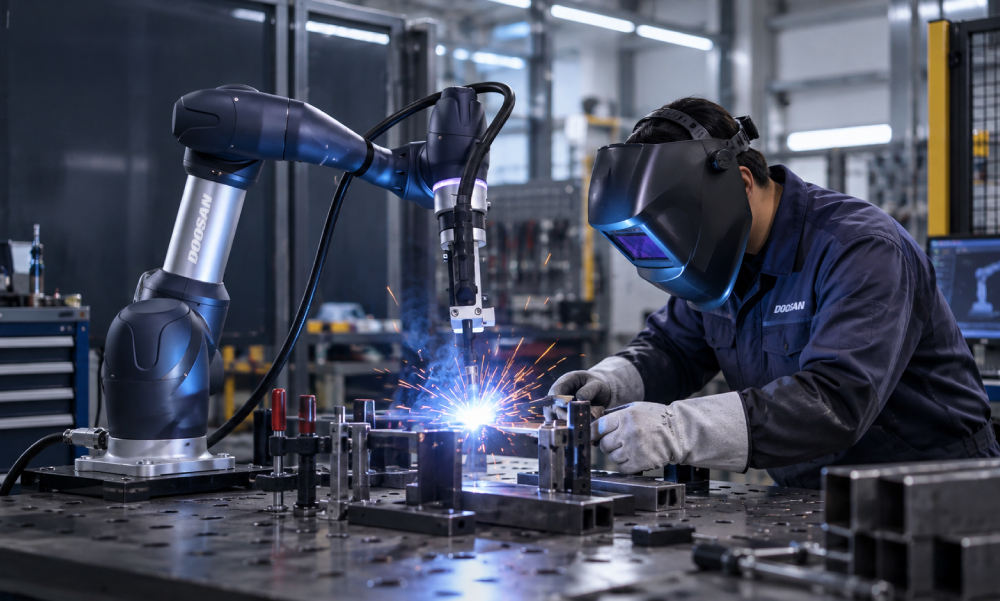
Welding cobots combine a collaborative robotic arm with a welding power source, torch, fixturing, controls, and application software. The robot follows programmed paths to maintain repeatable torch position, angle, travel speed, and motion.
Doosan Robotics welding solutions support processes including arc, TIG, and laser welding. In metalworking environments, these systems can help manufacturers automate repetitive welds while keeping skilled employees focused on setup, inspection, programming, and jobs that require more judgment.
Can Collaborative Robots Be Used for Welding?
Yes. Collaborative robots can be used effectively for welding when the complete application is properly evaluated and integrated. Welding applications also require consideration of factors such as arc flash, ultraviolet radiation, heat, sparks, fumes, electrical equipment, and pinch points.
The American Welding Society’s Safe Cobot Welding guidance emphasizes comprehensive risk assessment, worker training, protective equipment, maintenance, and appropriate safeguarding. OSHA also identifies hazards associated with robot operation, programming, setup, testing, and maintenance in its robotics safety guidance. The ISO robotics standards overview provides additional guidance on robotics safety and integration.
When planning a cobot welding application, evaluate the complete workstation, including:
1. Robot speed and reach
2. Welding torch and workpiece hazards
3. Fixtures and positioners
4. Arc, sparks, heat, and fumes
5. Operator access
6. Loading and unloading procedures
Depending on the welding process and workstation design, the system may incorporate screens, barriers, scanners, fume extraction, or other protective measures.
Are Cobots Good for Small-Batch Welding?
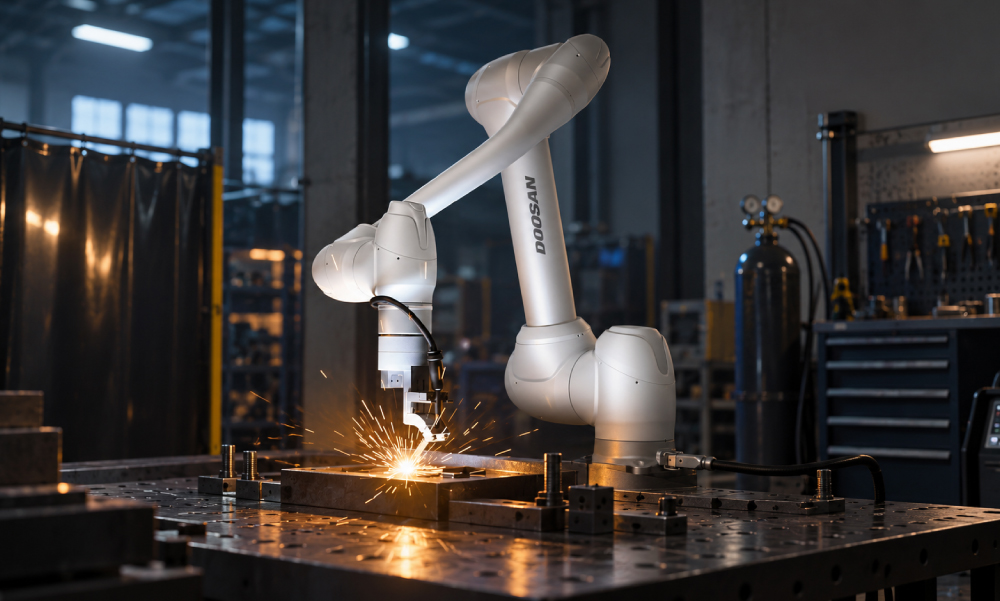
Yes. Cobots can be particularly useful for high-mix, low-volume welding because they can accommodate frequent changes in parts, fixtures, and weld programs. This flexibility can make automation practical even when manufacturers are not producing the same part continuously in high volumes.
For repeat jobs, your team can save and reuse welding programs, change fixtures for different parts, and adapt the cobot to other compatible welding tasks. This flexibility can make robotic arm welding practical for fabricators producing brackets, frames, enclosures, assemblies, and other products with repeatable weld paths.
Like other robotic welding systems, cobots perform best when parts and fixtures are consistent. Significant variation in part dimensions, gaps, or positioning may require improvements in part preparation or fixturing before automation.
How Do Welding Cobots Improve Weld Quality and Throughput?
A welding robotic arm can repeat programmed motion consistently from one cycle to the next. Stable torch angle, travel speed, and positioning can reduce operator-to-operator variation on suitable parts.
Throughput can also improve because an operator can prepare the next component, inspect finished work, or manage another task while the robot completes a weld cycle. The goal is usually to use skilled welding labor more effectively rather than remove human involvement entirely.
Robotic welding can affect metalworking ROI through factors including scrap reduction, rework reduction, cycle time, up-time, and labor utilization. Your ROI calculation should include equipment, tooling, fixtures, programming, application safeguards, training, maintenance, production volume, and changeover time.
How Do Cobots Compare With Traditional Robotic Welding?
Collaborative and traditional robotic welding systems are designed around different production requirements. Cobots are often well suited to manufacturers that need flexibility, frequent changeovers, operator interaction, approachable programming, or the ability to automate work without dedicating a large amount of floor space to a fixed cell.
Traditional robotic welding systems are often selected for applications centered on dedicated automation, sustained high-volume production, heavier payloads, or highly optimized cycle times.
Factors that can influence the type of welding automation you select include:
· Production volume and product mix
· Frequency of changeovers
· Required cycle time
· Part size, payload, and fixturing
· Available floor space
· Operator involvement
· Existing production-line configuration
· Safety and safeguarding requirements
The right solution should be selected around the welding application rather than the robot category alone. For many manufacturers, collaborative welding provides an effective balance of repeatability, flexibility, operator involvement, and adaptable deployment.
What Should You Evaluate Before Automating Welding?
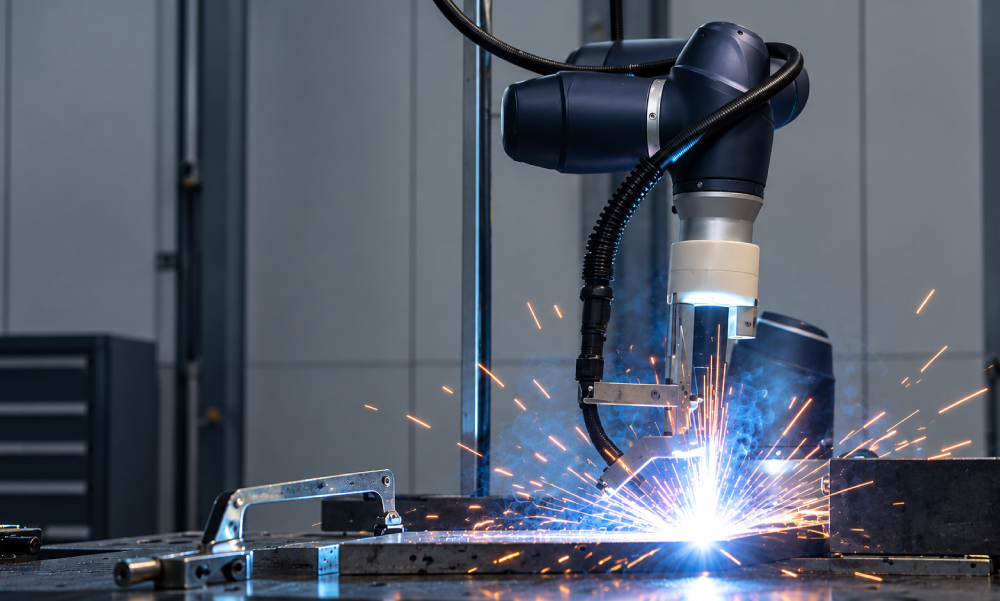
Before choosing automated welding solutions, start with the work itself. Ask:
1. Are the weld paths repeatable?
2. Can parts be positioned consistently?
3. How frequently do SKUs change?
4. What cycle time must you achieve?
5. How much operator involvement is required?
6. What safety controls will the application need?
7. How much rework and scrap occurs today?
8. What production volume supports the investment?
If integration experience is limited, a turnkey welding solution can reduce deployment complexity by bringing together the robot, welding equipment, fixtures, positioners, safety systems, programming, and application support.
When Does Cobots Welding Make Sense for Your Facility?
Cobot welding can be a strong fit when your operation has repeatable welds but also requires flexibility, frequent changeovers, operator involvement, or an adaptable automation footprint. These characteristics make collaborative welding especially valuable for manufacturers looking to automate more of their production without committing every application to a highly fixed process.
The best welding automation strategy starts with your parts, weld paths, production volume, throughput goals, available space, and safety requirements.
Contact us today to discuss your parts, weld paths, production volume, throughput requirements, safety needs, and ROI goals and determine whether collaborative welding automation fits your operation.
