

What Are Robotic Welding Systems?
2026. 06. 22
Robotic welding systems help companies automate repeatable weld tasks with better consistency and fewer production delays. If you are researching welding automation for the first time, it helps to think of robotic welding as a tool that improves repeatability while helping operators focus on setup, inspection, and workflow quality.
A robotic welding system uses programmed motion to perform welds with stable positioning and consistent speed. These systems are becoming easier to adopt because collaborative robots can fit inside existing production spaces
without requiring major layout changes.
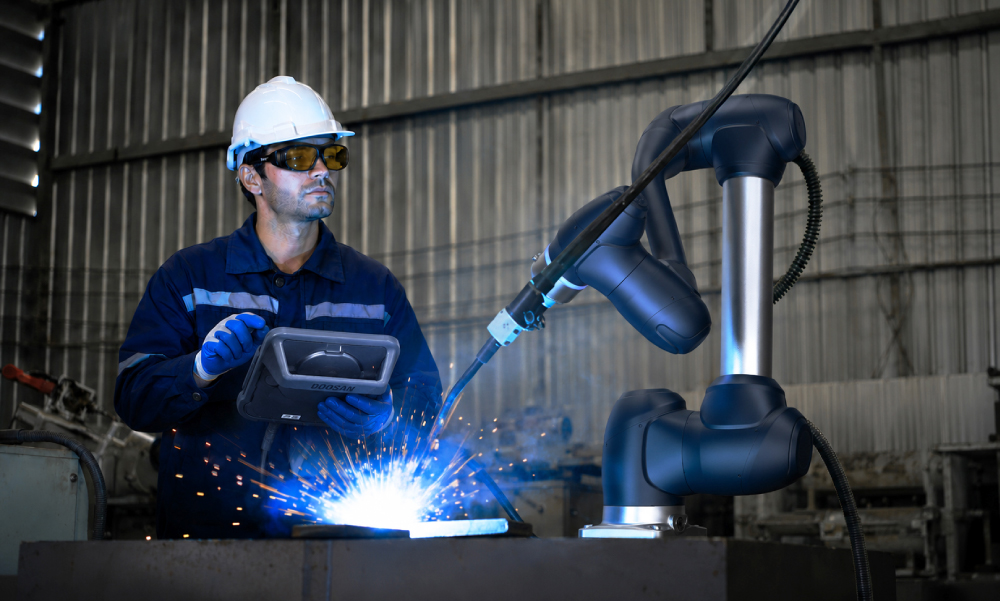
What Is Robotic Welding?
Robotic welding is the use of collaborative robots to perform repeatable weld operations with controlled movement and steady weld quality. Instead of relying only on manual welding, an automated welding system performs the same
weld path repeatedly with consistent torch motion.
A robot welding gun follows programmed movement to maintain stable weld geometry across repeated production cycles. Robotic welding systems are often used for structural frames, brackets, enclosures, and fabricated assemblies
where repeatability affects product quality.
Global automation adoption continues growing rapidly. Factories worldwide now operate over 4.28 million industrial robots, showing strong global demand for robotics welding technology across manufacturing environments.
What Are the Different Types of Welding Robots?
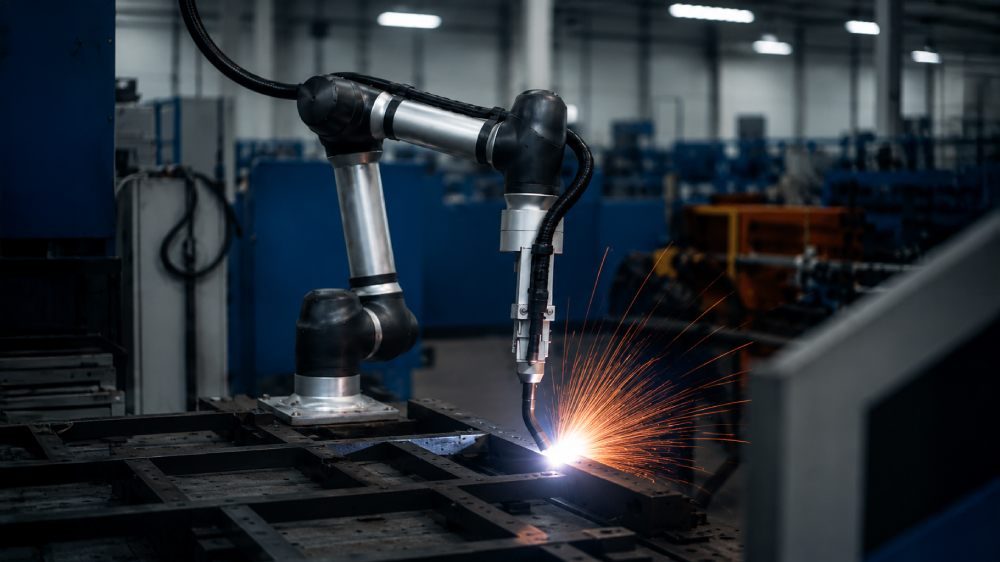
Different welding systems support different production needs. Collaborative robots can perform several welding styles depending on the application and material requirements.
Common applications include:
- MIG welding for fabrication work
- TIG welding for precision welding
- Spot welding for repeated connection points
- Arc welding for structural assemblies
- Multi-process cells for changing production needs
A robot welding gun or multiple robot welding guns may be configured differently depending on weld thickness, material type, and cycle time goals.
Production teams working across different industries often select welding automation based on repeatability requirements and production flexibility.
What is the Key Feature of an Automated Robotic Welding System?
The key feature of an automatic welding system is repeatability.
An automated welding system performs the same weld motion consistently across every production cycle. This helps improve weld quality and reduces variation between shifts.
Collaborative robots also improve flexibility because programming updates are often easier to manage than older fixed automation setups. This makes automated welding systems useful for facilities that regularly introduce new product variations.
How Do Robotic Welding Systems Work?
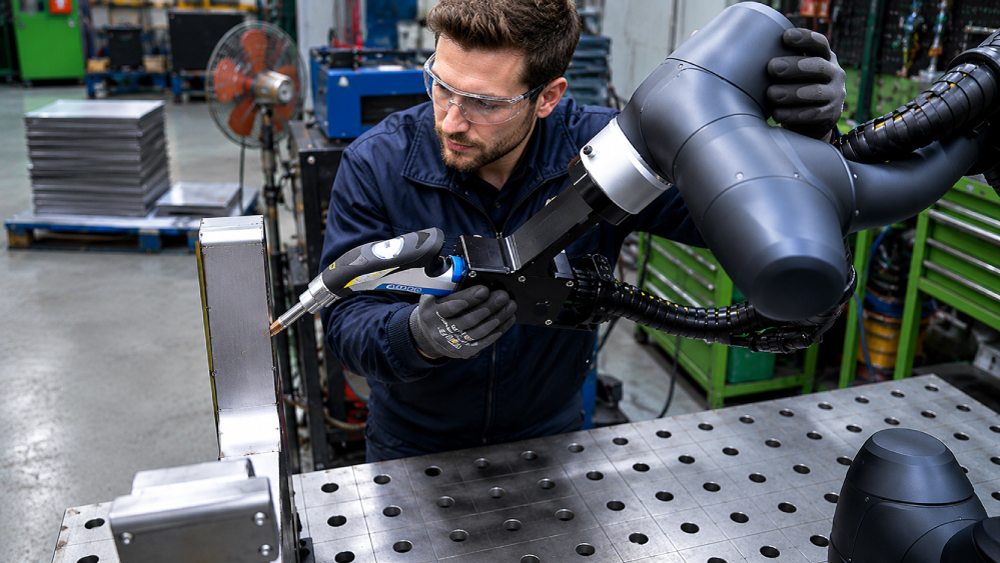
Robotic welding systems work by following programmed weld paths through coordinated movement and controlled torch positioning.
Typical system components include:
- collaborative robotic arm
- welding controller
- robot welding gun
- safety sensors
- part fixtures
- programming software
These components work together to maintain consistent weld movement while supporting production accuracy. Facilities looking for simplified deployment often benefit from turnkey solutions that support layout planning, setup, and
commissioning for collaborative welding cells.
Where Are Robotic Welding Systems Used?
Robotic welding systems are used anywhere repeatable weld quality improves production outcomes.
Common applications include automotive manufacturing and metalworking applications like structural steel production, enclosure manufacturing, and heavy equipment fabrication.
Collaborative welding automation continues expanding inside production environments because operators can load parts while the robot performs repeatable weld sequences. This flexibility helps support changing workflows across fabrication teams.
Vehicle production remains one of the strongest automation adopters globally. Recent global robotics reporting continues showing strong collaborative automation growth across vehicle production, which helps improve weld consistency throughout the automotive supply chain.
What are the Benefits of Robotic Welding?
The benefits of robotic welding often include better consistency, reduced rework, and improved production planning.
A collaborative robotic welding system helps production teams:
- improve weld repeatability
- reduce operator fatigue
- improve inspection consistency
- stabilize throughput
- support scalable automation
These improvements help explain why welding robot companies continue expanding collaborative automation into fabrication environments.
Programming also continues improving through AI supported automation. Recent examples of AI transforming robotic welding programming in metalworking show how collaborative automation is improving programming speed and
production flexibility.
Are Robotic Welding Systems Difficult to Adopt?
Robotic welding systems are often easier to adopt than people expect.
Collaborative robots can fit into existing production layouts and usually require less floor space than traditional caged robot systems. Training and setup have also become easier as robotic welding technology continues improving.
Production teams researching automation often begin by evaluating existing workflows and deciding where an automated welding system could improve consistency or reduce bottlenecks.
Why Collaborative Robotic Welding Continues to Expand
Robotic welding systems help improve repeatability, support stronger production consistency, and make welding automation easier to scale across fabrication environments. Contact us today to learn more and schedule a consultation call to discuss your needs.
FAQs
Can A Robotic Welding System Work Alongside Operators?
- Yes. Collaborative robots are designed to work closer to people than traditional caged automation systems. Operators can load components while the robot performs repeatable weld passes.
What Industries Use Robotic Welding Systems?
- Robotic welding systems are commonly used in fabrication, automotive production, equipment manufacturing, enclosure building, and structural steel applications where repeatable weld quality matters.
How Long Does It Take To Set Up An Automated Welding System?
- Setup depends on weld complexity and fixture requirements. Collaborative systems often reduce setup difficulty because programming and layout integration are easier than older automation approaches.
Do Welding Robot Companies Help With Installation?
- Yes. Most welding robot companies provide programming guidance, setup support, operator training, and deployment planning to improve adoption.
