

Automated Pallet Racking vs. Robotic Palletizing Systems
2026. 09. 08
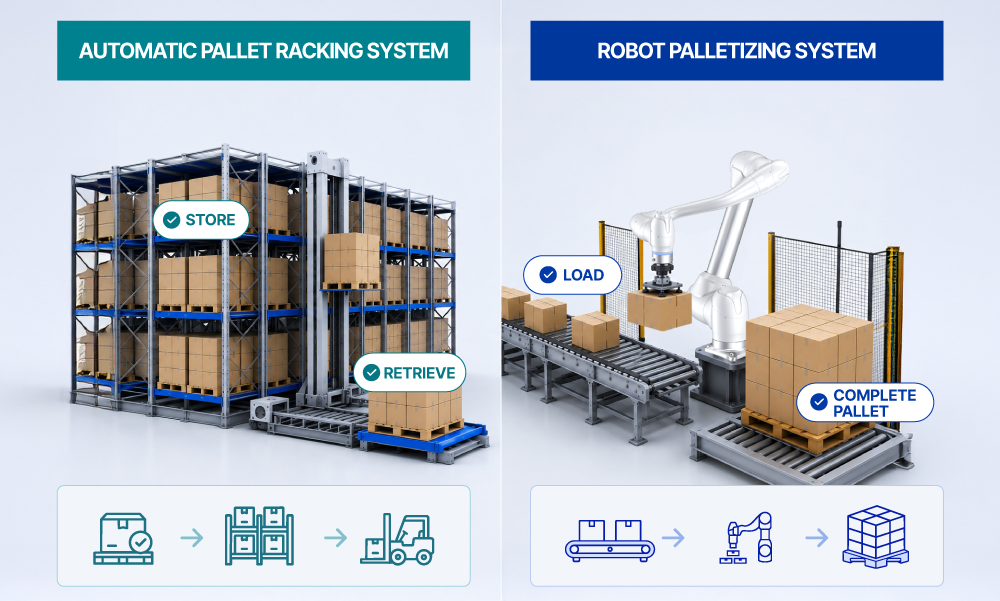
An automated pallet racking system and a robotic palletizing system solve different challenges in warehouses, distribution centers, and manufacturing facilities. An automated pallet racking system stores and retrieves completed pallets, while a robotic palletizing system creates those pallets by stacking cases, boxes, trays, or containers at the end of a production or packaging process.
These technologies are often discussed together because they can work as part of the same connected facility. However, they are not direct replacements for one another. One improves storage and inventory movement. The other
improves end-of-line production, packaging efficiency, and repetitive material handling.
According to the 2025 MHI Annual Industry Report, supply chain leaders continue to prioritize automation, artificial intelligence, and digital technologies as major areas of investment. The report found that 55% of supply chain leaders expected to increase spending on technology and innovation. This continued investment reflects the growing demand for automation across manufacturing, warehousing, and logistics operations.
What Is the Difference Between Automated Pallet Racking and Robotic Palletizing?
An automated pallet racking system uses automated storage and retrieval technology, software, conveyors, and robotic equipment to place pallets into storage locations and retrieve them when needed. These systems are designed to
improve warehouse organization, inventory accuracy, and available storage capacity.
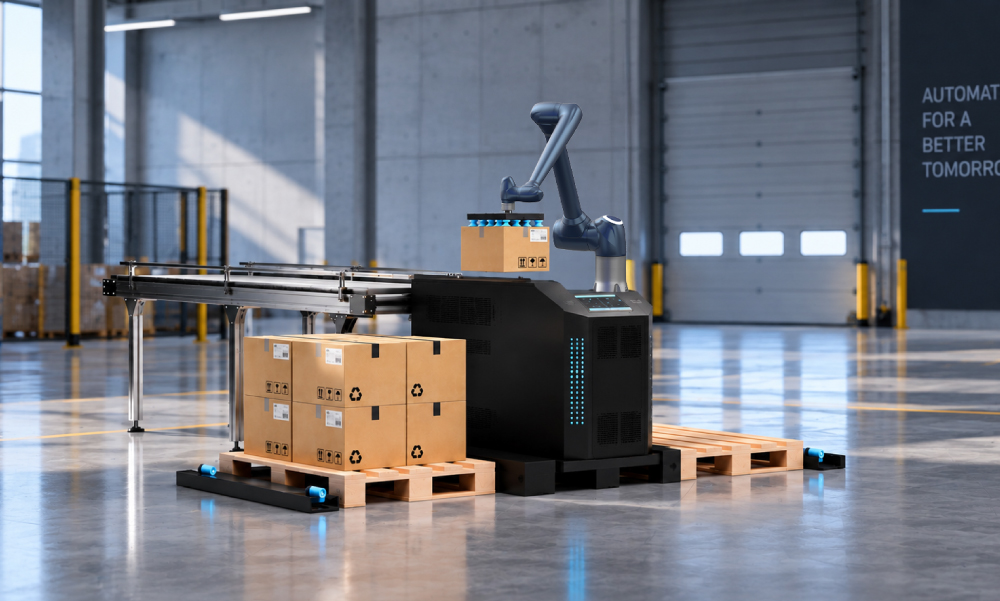
A robotic palletizing system uses robotic arms, sensors, tooling, and software to stack products onto pallets. These systems are typically located near the end of a production line, packaging line, or distribution operation.
A simple way to understand the difference:
1. Palletizing creates the finished pallet.
2. Pallet racking stores and retrieves the finished pallet.
3. Together, they create a more efficient material handling automation system.
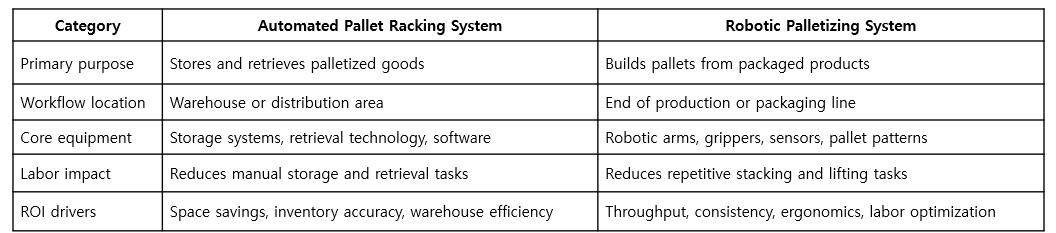
How Do Automated Pallet Racking Systems and Robotic Palletizing Systems Compare?
When Should You Use a Robotic Palletizing System?
A robotic palletizing system is usually the right solution when your challenge occurs before storage. If employees are manually stacking cases, lifting repetitive loads, or adjusting inconsistent pallet patterns, automation can improve efficiency and consistency.
Common applications include:
1. Food and beverage packaging
2. Consumer packaged goods
3. Pharmaceutical secondary packaging
4. Household products
5. Industrial manufacturing
6. Distribution operations
Robotic palletizing solutions can help create repeatable pallet patterns, reduce physical strain, and maintain production flow as demand changes.
Robotic Palletizing vs. Manual Palletizing
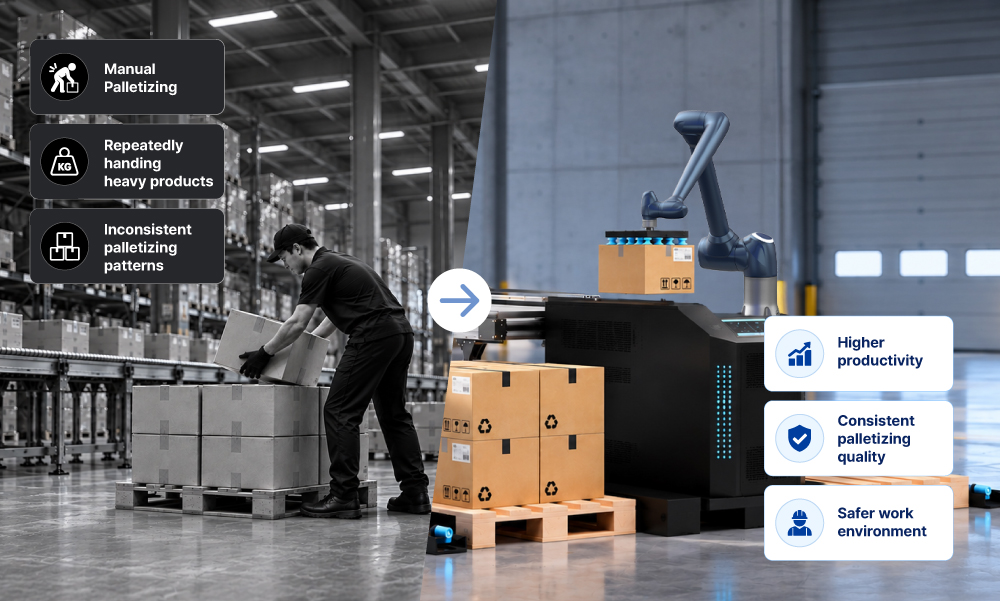
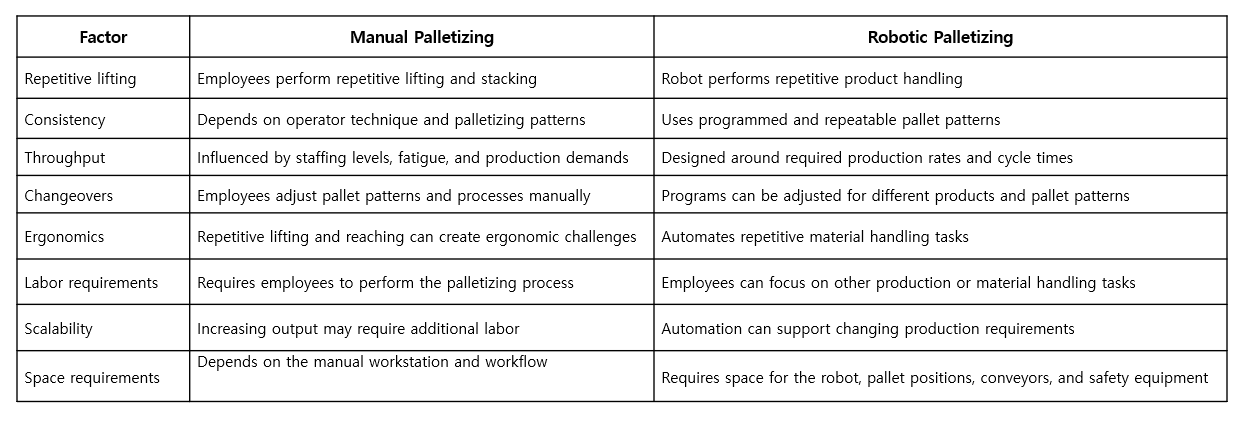
Many manufacturers begin evaluating robotic palletizing after identifying repetitive manual palletizing as a production or workforce challenge. Manual palletizing requires employees to repeatedly lift, move, and stack products onto pallets, while a robotic palletizing system uses a programmed robot and end-of-arm tooling to perform these repetitive handling tasks.
The right approach depends on factors such as production volume, product weight, number of SKUs, pallet configurations, available labor, and required throughput. For operations with repetitive palletizing requirements, robotic
automation can improve consistency while reducing the amount of manual lifting required.
When Does Robotic Palletizing Make Sense?
Robotic palletizing can be valuable when manufacturers face repetitive lifting, inconsistent pallet patterns, end-of-line bottlenecks, increasing production volumes, or frequent SKU changes.
A robotic palletizing system can handle repetitive material handling tasks while employees focus on machine operation, quality control, and other production activities.
Before automating, consider product weight and dimensions, pallet height, required throughput, gripper design, and available floor space.
Can Cobots Help with Palletizing and Depalletizing?
Yes. Collaborative robots, also called cobots, can support palletizing, depalletizing, and other material handling applications when the system is properly designed and evaluated.
Cobots can help move cases from conveyors, unload containers, handle repetitive transfers, and support production environments where logistics flexibility is important. They are especially useful when manufacturers need smaller footprints, frequent changeovers, or easier operator interaction.
However, collaborative operation does not remove the need for safety planning. OSHA explains that robotic applications require proper safeguards because hazards can occur during operation, programming, maintenance, and
setup.
Doosan Robotics solutions help manufacturers evaluate where robotic automation can improve repetitive movement tasks.
How Can These Systems Work Together?
Many modern facilities use both technologies because they address different parts of the workflow.
For example, a food manufacturer may use a robotic palletizing system after packaging. The robot stacks sealed cases onto pallets using a programmed pattern. Once complete, an automated storage system can move those pallets into inventory until they are needed for shipping.
A distribution center may use robotic stacking and automated storage together to improve product movement from receiving through fulfillment.
This combination creates a connected robotics material handling strategy where production, storage, and distribution work together more efficiently.
What Is the Best Automation Option for End-of-Line Pallet Handling?
If your biggest challenge is manually stacking products at the end of production, a robotic palletizing system or automatic palletizer is usually the technology to evaluate first.
Before selecting equipment, compare:
1. Product dimensions and weight
2. Required cases per minute
3. Number of SKUs
4. Pallet patterns and heights
5. Available floor space
6. Required changeover speed
7. Integration requirements
8. Safety considerations
A smaller collaborative system may fit operations with moderate throughput and frequent product changes. A larger industrial robotic system may be better for continuous, high-speed production.
Doosan Robotics’ P3020 provides a higher-payload collaborative robot option for applications requiring flexible robotic handling.
Which One Do You Need?
The best solution depends on where your operational challenge occurs.
Choose robotic palletizing when:
1. Employees manually stack cases or containers.
2. End-of-line production is limiting throughput.
3. Repetitive lifting creates ergonomic concerns.
4. Product changes require flexible pallet patterns.
Choose automated pallet racking when:
1. Warehouse space is limited.
2. Inventory retrieval is inefficient.
3. Storage organization is difficult.
4. Pallet movement requires additional automation.
Choose both when you want a connected production and distribution workflow.
What Should You Evaluate Before Investing?
Before selecting equipment, answer these questions:
1. Are you solving a production problem or a storage problem?
2. What products and pallet configurations must the system support?
3. What production rate must be achieved?
4. How much space is available?
5. What environmental conditions exist?
6. How will the system integrate with existing equipment?
A turnkey solution can help simplify implementation by combining equipment selection, programming, integration, and deployment planning. Robotic palletizing systems support modern manufacturing workflows in a variety of ways.
Manufacturers should also consider worker ergonomics when evaluating manual lifting tasks. The NIOSH Revised NIOSH Lifting Equation provides guidance for assessing lifting risks and workplace design.
Automated pallet racking systems and robotic palletizing systems solve different problems, but together they can create a more efficient material handling strategy. The right choice depends on your workflow, production requirements, storage needs, and long-term automation goals.
Contact us today to discuss which robotic automation approach best fits your manufacturing, warehouse, and material handling objectives.
