

What Embodied Reasoning AI Could Mean for Real-World Palletizing
2026. 04. 09
A recent first-place project from a team of Doosan Robotics engineers offers a useful way to think about where palletizing may be headed next. At the NVIDIA Cosmos Cookoff, Doosan Robotics engineers earned the top prize with “See How It Thinks: Mixed Palletizing with Explainable Visual Reasoning,” a proof-of-concept built around a practical warehouse problem: what happens when the box in front of the robot is not in perfect condition, and the right handling decision is no longer obvious?
That question matters because palletizing usually works best when conditions are stable. Cases are consistent. Packaging is intact. The load pattern is known. In that setting, standard automation can perform very well. The trouble starts when the real operating environment introduces variation. Boxes arrive dented. Fragile goods are mixed in. Packaging quality changes by supplier or by shift. Once those variables show up, the issue is no longer just whether the robot can complete the motion. The issue is whether the system can make a sound handling decision before the mistake turns into damaged product, rework, or an unstable load.
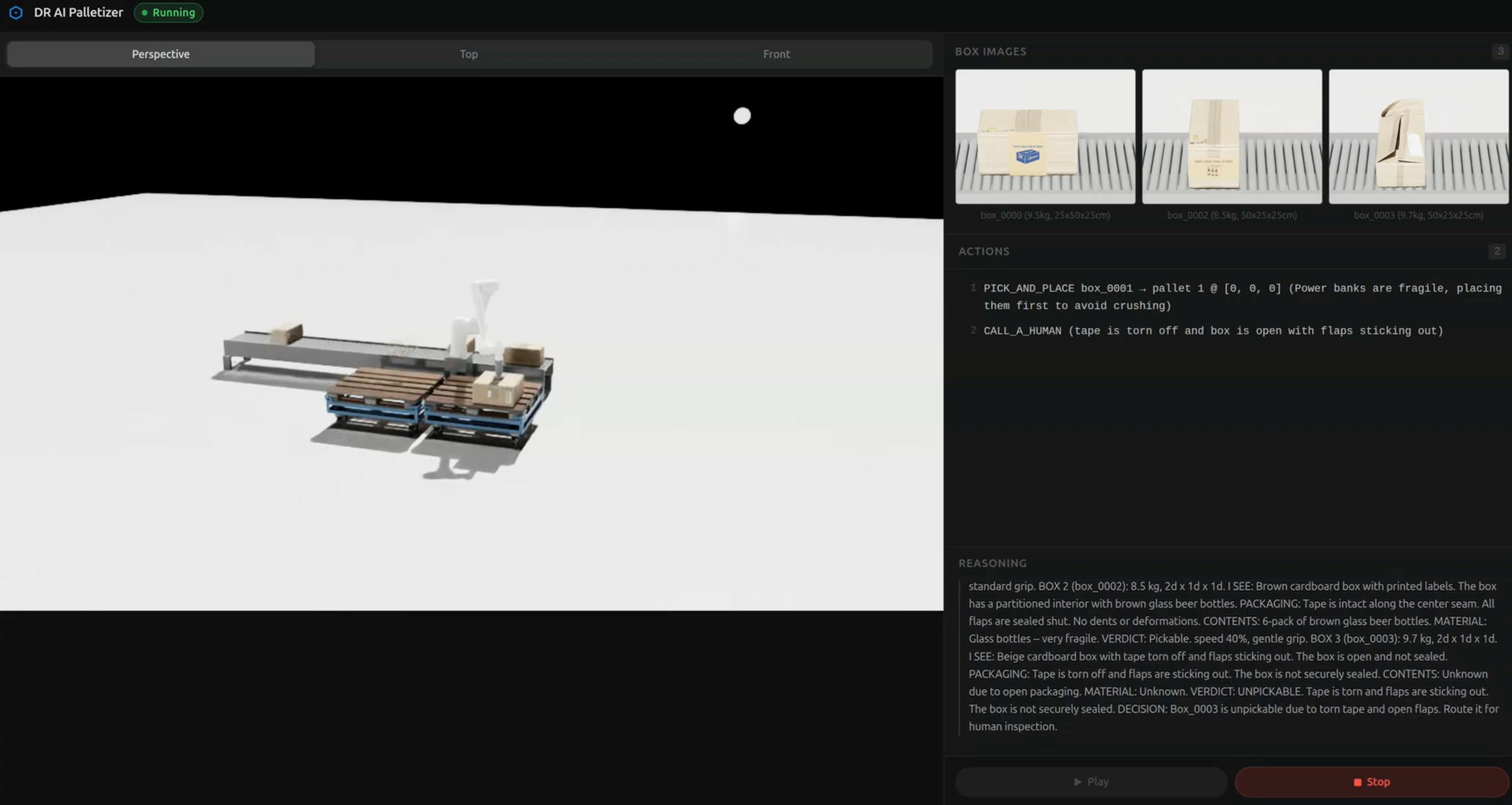
The Doosan Robotics project approached that problem by asking whether Embodied Reasoning AI could help the system judge what it is handling, adjust its actions, and provide a reason for those decisions. In the concept demonstrated by us, the system uses visual input to assess a case, identify potential damage or handling risk, and then inform how that case should be placed. The important point is not AI for its own sake. The important point is whether that additional layer of judgment can make palletizing more reliable in the situations that create the most operating pain.
Why this matters on the floor
Most automation buyers do not struggle with the clean, repeatable case. They struggle with the exceptions.
A damaged carton that still gets stacked. A fragile case that is handled too aggressively. A load that looks acceptable during the cycle but becomes unstable later. Those are the moments that create cost. They lead to product loss, manual inspection, operator intervention, and questions about whether the system can really be trusted outside a controlled demo.
That is why the idea behind this project is relevant. It points to a future in which palletizing systems may not be limited to following fixed rules. In some applications, they may also be able to evaluate the condition of what they are handling and respond with more context than a static program allows.
For operators, that is a meaningful distinction. A robot that repeats the same motion every time has value. A robot that can also recognize when the situation calls for a different response has the potential to create a different level of value, especially in environments where exceptions are common.
Why explainability matters as much as intelligence
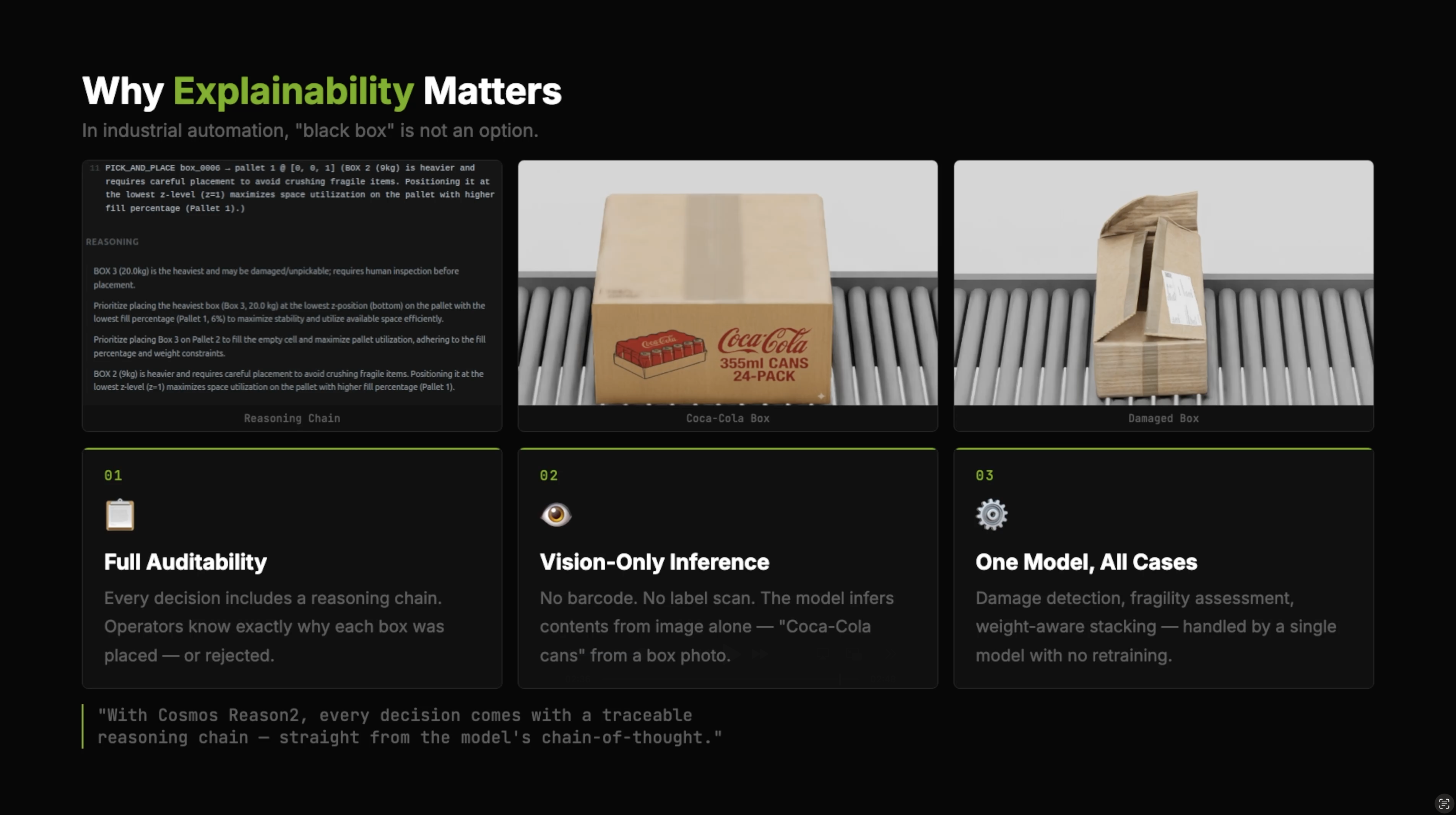
One of the more practical aspects of this project is not just that it uses AI, but that it centers on explainability.
In industrial operations, a decision is much easier to accept when people can understand why it was made. If a case is flagged, operators want to know what triggered the flag. If the system changes how it handles a box, engineers want to know what condition it detected. If something goes wrong, the engineers needs a way to review the decision path and improve the logic.
That matters because a black-box system is hard to manage in a production environment. Performance alone is not enough. We also need traceability, especially when the automation is affecting product quality, load stability, or material flow.
For customers, this is where the business relevance becomes clearer. The value is not the AI label. The value is better control over the exceptions that create real cost. If a system can reduce preventable damage, lower manual intervention, and make its decisions easier to review, it becomes easier to justify and easier to trust.
What this could mean for palletizing buyers
None of this suggests that every palletizing application suddenly needs advanced reasoning. Many applications will continue to be well served by conventional automation, especially where packaging is consistent and operating conditions are tightly controlled.
But that is not every palletizing environment.
Where there is mixed product flow, variable packaging quality, fragile goods, or frequent exception handling, the limits of fixed logic show up more quickly. In those
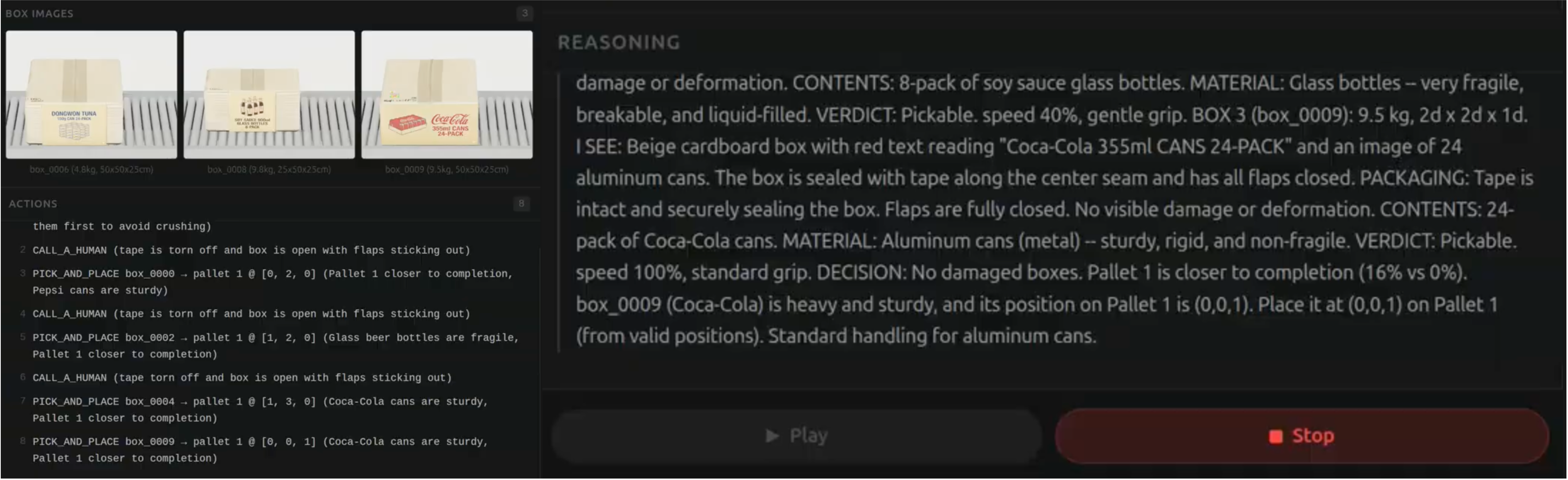
cases, a more context-aware system becomes more interesting. Buyers start asking a different question. Not simply, “Can the robot palletize this?” but, “Can the system make good decisions when the inputs are less than ideal?”
That is usually a better commercial question. Throughput matters, of course. So do cycle time and footprint. But in many operations, the real return comes from reducing the messy, recurring problems that sit around the main process: damaged cases, unnecessary checks, unplanned stops, and manual recovery work.
Explore Doosan Robotics palletizing applications
Effective palletizing starts with understanding the real requirements of the end of line, including load quality, product variation, throughput, and operating constraints. See how Doosan Robotics approaches palletizing applications with those needs in mind.
Explore palletizing applications
Why this project is worth paying attention to
What makes this project notable is not just the result, but the problem it chose to address. It focused on a part of palletizing that operators already recognize: boxes do get damaged, fragile product does get mishandled, and fixed logic does run into situations it was never designed to interpret. That makes the work more relevant than a generic AI demo because it is tied to a real operational question.
For customers, partners, and technical engineers, that is the useful takeaway. This project offers a concrete example of how AI might be applied to a familiar industrial task in a way that connects back to handling quality, process control, and exception management.
Where the business relevance sits
The business case for palletizing automation has always extended beyond simple motion. It sits in load quality, product protection, labor efficiency, uptime, and consistency at the end of the line. As more companies look at AI in automation, the useful question is not whether the technology sounds advanced. The useful question is whether it can improve outcomes in the parts of the workflow where conventional logic starts to struggle.
That is the real value of this kind of work. It helps shift the conversation from abstract AI claims to a more grounded issue: can a palletizing system make better decisions when the case in front of it is not perfect?
For companies evaluating automation, that is a question worth watching closely.
Discuss your application
If you are evaluating palletizing automation or a broader end-of-line opportunity, we can help review your requirements and operating conditions.
Interested in building this kind of technology?
Doosan Robotics is continuing to explore how AI, simulation, and robotics come together in real industrial environments. If this is the kind of work you want to do, take a look at our current openings.
View AI job postings at Doosan Robotics
