

Why Pick & Place Collaborative Robots Are the Smart Choice
2026. 04. 10
On factory lines, pick-and-place tasks—grasping and moving objects—are repeated thousands of times every day. In manufacturing,, Pick & Place operations are are among the most frequent processes and also the area where automation delivers the fastest returns. Despite this, many sites still rely on manual labor.
The reason has been clear until now: traditional industrial robots require high upfront investment, demand significant installation space, and need reprogramming whenever the process changes. Collaborative robots (cobots) are changing this equation.

Why Should Humans Continue Handling Repetitive Work?
Korean manufacturing is facing a structural labor shortage. Simple, repetitive operations suffer from high turnover, while operator fatigue leads to quality variation. Overtime and night-shift costs continue to rise, and the risk of industrial accidents remains high—especially in heavy or hazardous processes.
Key challenges include:
• Frequent turnover and hiring difficulties for repetitive labor roles
• Defect rates and quality fluctuations depending on operator skill level
• Rising overtime and night-shift costs, creating unstable production forecasts
• Ongoing safety risks in heavy-load and high-risk operations
These trends are supported by data. According toto the International Federation of Robotics (IFR) in its World Robotics 2024 report, South Korea recorded the world’s highest robot density in 2023, with 1,012 robots per 10,000 employees, ranking first globally. This equates to roughly one robot for every ten workers, highlighting how rapidly Korea is transitioning toward robot-based manufacturing. (Source: IFR World Robotics 2024)
The Korean business daily Herald Economy also reported that industry experts expect the collaborative robot market in Korea to continue expanding each year, driven by population aging and labor shortages. (Source: Herald Economy, Sept. 25, 2025)
What Makes Doosan Robotics’ Pick & Place Solution Different?
Doosan Robotics integrates its collaborative robot arm, grippers, system components, and dedicated software into a complete solution that automates the entire “pick–move–place” workflow.
The system is compatible with most vision systems, allowing customers to select and integrate their preferred vision cameras. By combining 3D vision, vacuum grippers, and other end effectors, the solution can be rapidly deployed across various applications such as:
• Metal press handling
• Injection-molded part handling
• Component packing
Because cobots can safely operate without safety fences, they can share workspace with human operators. Installation requires minimal layout changes, and robots can be easily deployed between existing equipment.
ROI as Defined by Doosan Robotics 👉For material and product handling processes—such as pick & place, bin picking, and loading/unloading—Doosan Robotics provides ROI simulations to estimate the average payback period before deployment.
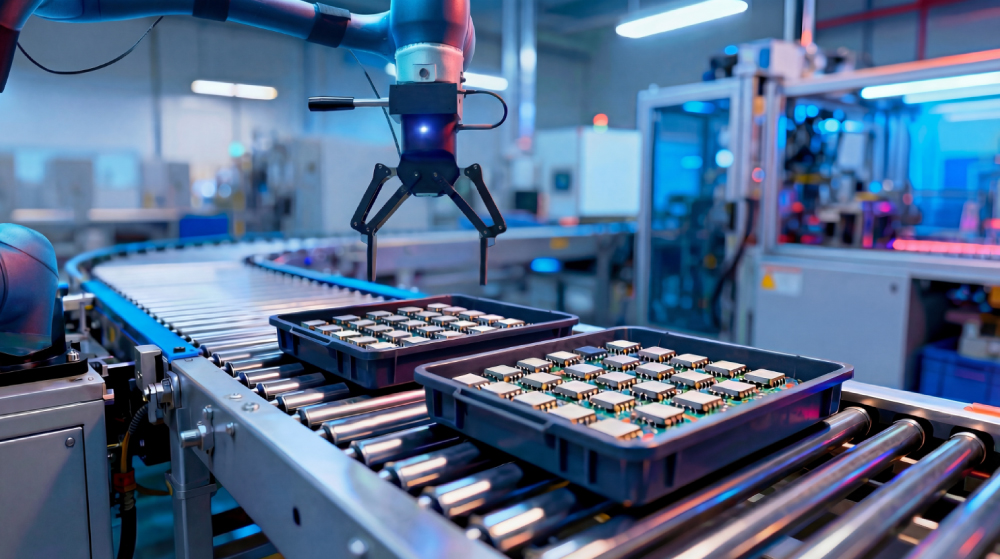
Three Core Technologies
1. Six-Axis High-Performance Torque Sensors — Precision Like a Human Hand
A key differentiator of Doosan Robotics’ collaborative robots is their proprietary six-axis high-performance torque sensors, installed in every joint. These sensors detect minute force changes in real time, allowing the robot to handle products of slightly different shapes and weights without damage.
This makes them suitable for delicate materials such as glass, food products, and electronic components.
Based on this technology, Doosan cobots achieve the highest ISO safety rating (PLe, Category 4) and have also earned the top grade in TÜV SÜD international safety certification.
They can detect contact with a human within 0.1 seconds and stop immediately, while maintaining repeatability of ±0.03–0.1 mm.
2. Dart-Suite — Change Processes Without Coding
Dart-Suite, Doosan Robotics’ software platform, controls collaborative robots through a structure similar to a smartphone app store.
Users create workflows using drag-and-drop, and when a process changes, switching to a different app allows immediate adaptation—without complex programming.
This enables shop-floor operators with no coding expertise to directly operate the robot.
Dart-Suite consists of:
• Dart-IDE: A web-based app development environment
• Dart-Store: An app marketplace for downloading process-specific applications
• Dart-Platform: Centralized management for robot operation and app installation
A single robot can perform electronic component pick & place in the morning and packaging or labeling tasks in the afternoon—maximizing utilization.
3. AI Vision System — Accurate Handling of Unstructured Objects
Combined with 3D vision, Doosan Robotics’ Pick & Place solution maintains stable recognition and gripping even in irregular container layouts or with unstructured objects.
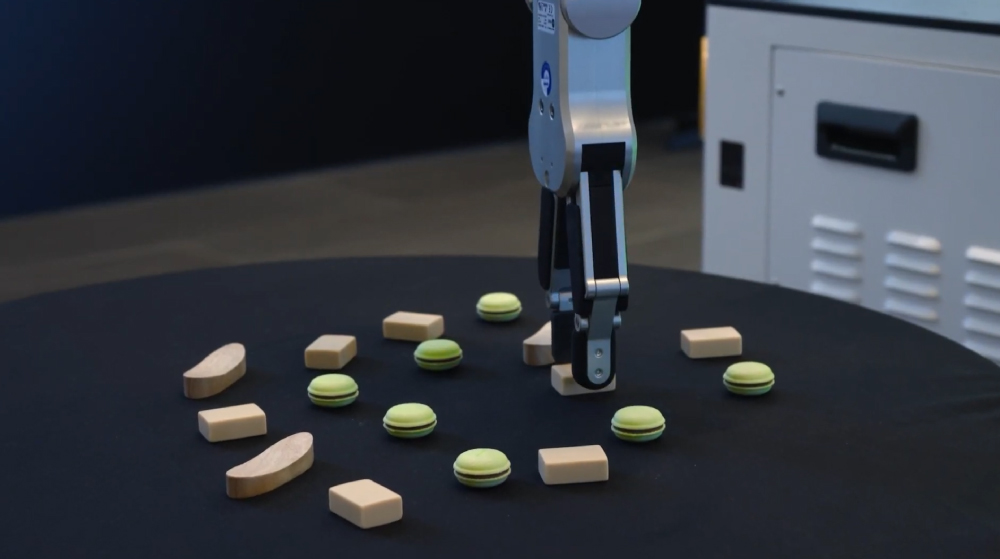
A low-cost, high-efficiency method is also used, where the gripper measures force and size differences at the moment of grasping to identify objects. This technology won the CES 2024 Innovation Award (Artificial Intelligence category). It is especially effective in high-mix, low-volume production environments where product changes are frequent. Compared to jig-dependent automation, this solution provides significantly higher flexibility, maximizing ROI in variable production settings.
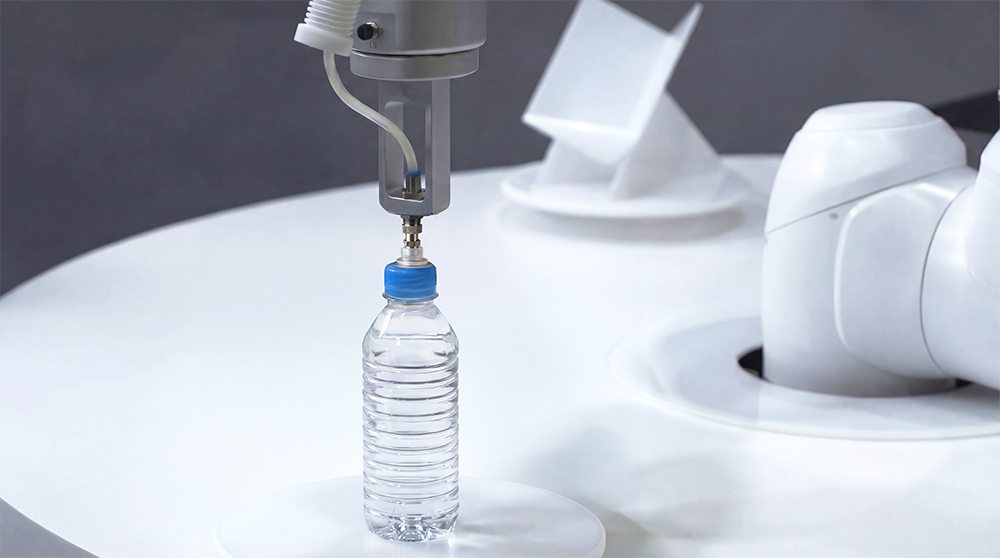
Proven in Real Manufacturing Environments
Below are representative cases where Doosan Robotics’ Pick & Place solutions have been deployed successfully:
- Electronics & Semiconductors - PCB transfer and inspection equipment loading +28% productivity, −18% defect rate
- Food & Beverage - Box sorting and palletizing Replaced 2.5 workers, ROI achieved in 19 months
- Automotive Parts - Machine tending and metal part loading 20% cycle-time reduction, zero safety incidents
- Press & Metal Lines - Heavy steel plate loading automation 1-year ROI target, reduced worker turnover
- Logistics & E-commerce - Box picking, sorting, conveyor loading 40% faster order processing, 30% efficiency gain
Notably, in press line applications, projects were completed in under 8 weeks, including:
• 4 weeks for design
• 2 weeks for fabrication
• 2 weeks for installation and stabilization
ROI simulations are provided upfront, enabling decision-makers to evaluate investments based on quantitative data.
Collaborative Robots vs. Traditional Industrial Robots
Collaborative robots are not simply smaller industrial robots—they differ fundamentally in deployment, cost structure, and flexibility.
- Deployment Time Approx. 8 weeks for standard processes Often several months due to customization
- Initial Investment Accessible for SMEs, average payback within 2 years Higher CapEx including safety equipment
- Process Change Instant switching via Dart-Suite apps Requires reprogramming and jig redesign
- Operation Shop-floor operators can teach and operate High dependence on specialized robot engineers

Frequently Asked Questions
Can installation be done without stopping the production line?
Yes. With a compact footprint and simplified setup, Doosan Robotics’ cobots require roughly half the installation effort of conventional six-axis robots.
AC/DC controllers also enable integration with AGVs and AMRs, allowing phased installation without line shutdown. Expert engineers assess the site and propose optimal layouts.
Can non-experts operate the system?
Yes. Thanks to Dart-Suite’s intuitive UI and Easy Teaching functions, operators can manage basic operation and process changes without complex programming. Independent operation is typically possible after 1–2 weeks of stabilization.
Is it suitable for high-mix, low-volume production?
Absolutely. Flexibility is maximized in environments with frequent product changes. Dart-Suite app switching and AI vision recognition minimize reprogramming time, enabling rapid response to new products.
How is safety verified?
Doosan Robotics cobots meet ISO PLe, Category 4, and have earned top ratings from TÜV SÜD.
Six torque sensors detect contact within 0.1 seconds, allowing safe operation alongside humans without safety fencing.
Where Should You Start with Pick & Place Automation?
The biggest barrier to automation adoption is uncertainty—“Will this fit our process?”
To address this, Doosan Robotics provides on-site diagnostics and ROI simulations before deployment. Based on labor allocation, equipment utilization, and product specifications, customers can quantitatively assess automation potential and expected payback periods.
Once deployed, a collaborative robot is not limited to Pick & Place. With the Dart-Suite platform and AI-based control, it can be expanded to machine tending, assembly, inspection, and more—reducing total cost of ownership (TCO) over time.
