

What if 0.05mm determined your yield and profit?
2026. 03. 24
Imagine marking a single microscopic dot on a piece of paper — 10,000 times in a row. For human hands, hitting the exact same spot each time without even a hair's-breadth of deviation is simply impossible. For Doosan Robotics' collaborative robots, it's just another day at work. The flawless finish of the smartphone in your pocket and the consistent taste of your morning coffee — both depend on the extraordinary ability of robots that never make mistakes.
Many manufacturers evaluating robot adoption focus exclusively on "accuracy" — and in doing so, overlook a far more critical metric: Repeatability. In this article, we explore what repeatability means, why it matters, the key technologies that make it possible, and the real business value it creates on the Pick-and-Place production floor.
1. What Is Repeatability?
In robotics, repeatability refers to a robot's ability to return to the same position consistently each time it performs the same motion. It is frequently confused with accuracy, but in industrial settings, repeatability is treated as the far
more critical specification.
1.1 Repeatability vs. Accuracy
Picture a game of darts. The distinction between these two concepts becomes immediately clear.
• Accuracy: When you command a robot to "move to coordinate A," accuracy is how closely it arrives at the theoretical target. It is the ability to hit the bullseye — the precision of a single throw.
• Repeatability: When you command a robot to "go to coordinate A one thousand times," repeatability is how tightly clustered those thousand results are. Even if every dart lands slightly off-center, repeatability means they all land in the same spot. In manufacturing, this "digital muscle memory" — the ability to produce identical results thousands of times — is far more valuable than a single lucky throw.
Because operators teach a robot its working positions directly, the robot's ability to reproduce those positions tens of thousands of times is what truly matters. High repeatability is ultimately the most critical hardware specification for process reliability.
2. Why Repeatability Matters
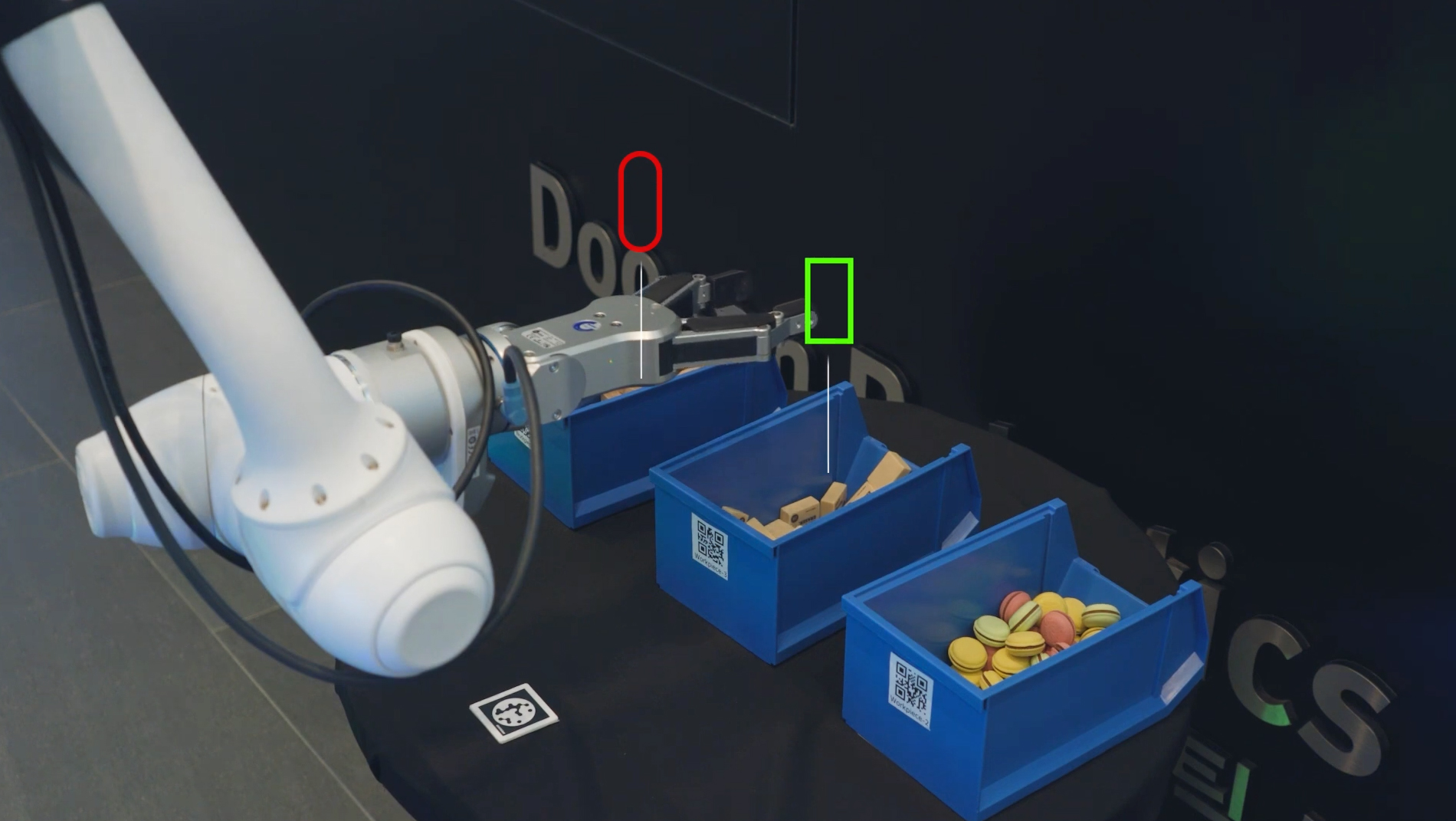
Even the most skilled craftsperson experiences variation in touch depending on their physical condition. After tightening thousands of tiny screws in a single day, fatigue accumulates, microscopic tremors develop, and assembly defects follow. A Doosan robot, by contrast, leverages digital muscle memory to ensure that its ten-thousandth motion is indistinguishable from its first — 24 hours a day.
Most industrial robots operate on a "teaching" model: an operator manually guides the robot to a position once, and the robot must reproduce that motion reliably thousands of times afterward. Consistent movement is not optional — it is foundational.
• Quality Assurance: In semiconductor or display assembly, a deviation of just 0.05mm can crack a component or generate a defect. By preventing a single misplaced screw from scrapping an expensive motherboard, robots become ideal workers for manufacturers determined to minimize defect rates.
• Production Efficiency: Low repeatability forces mid-process positional corrections, increasing downtime and reducing throughput.
• Equipment Longevity: When a robot cannot position itself correctly, forced insertions and collisions accelerate wear on the robot arm and surrounding fixtures.
2.1 Factors That Affect Repeatability
• Structural Rigidity: Joints and links must be stiff enough to resist deflection under load.
• Gear Backlash: The smaller the play between gear teeth, the higher the positional precision.
• Thermal Expansion: Heat generated during extended operation causes metal components to expand slightly, introducing drift into positional accuracy over time.
3. The Core Technologies Behind Repeatability
How does a robot consistently find the exact same narrow target without eyes? The answer is not simply a rigid mechanical arm. Achieving high repeatability requires a combination of hardware engineering to overcome physical limitations and software control to compensate for what hardware cannot.
3.1 High-Precision Actuation and Mechanical Design
For a robot to return to the same position every time, all mechanical play must be minimized.
• Zero-Backlash Reducers: Harmonic drives and RV reducers minimize the gap between gear teeth, eliminating micro-vibrations at each joint.
• High-Rigidity Structural Design: High-stiffness materials and structural geometry prevent the arm from deflecting under inertial and gravitational loads during motion.
• High-Resolution Encoders: Sensors capable of dividing a single motor revolution into millions of increments allow the robot to track its current position with extraordinary granularity.
3.2 Intelligent Control and Compensation Algorithms
Software compensates in real time for what hardware cannot fully eliminate.
• Robot Calibration: Measurement equipment such as laser trackers quantifies the difference between a robot's actual dimensions and its design specifications, generating correction parameters to eliminate systematic error.
• Thermal Displacement Compensation: Temperature sensors continuously monitor heat buildup and apply real-time positional adjustments to counteract thermal expansion.
• Model-Based Control: Mathematical models of the robot's mass, friction, and gravity predict positional errors before they occur and apply pre-emptive corrections.
3.3 External Feedback and Sensing Technologies
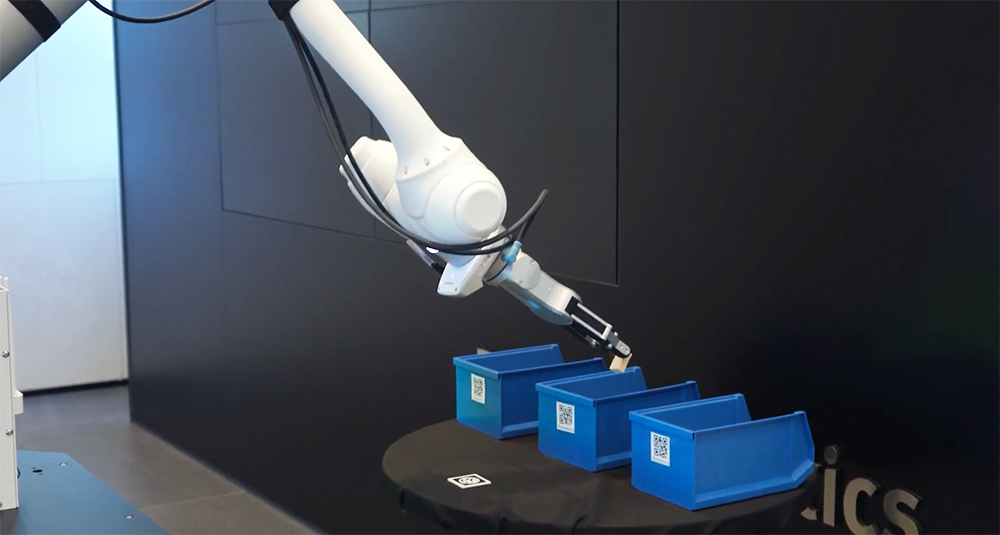
Even the best marksman cannot hit a target blindfolded. If repeatability is the robot's "steady hand," external feedback technologies are its "sharp eyes" — identifying the exact position of the target regardless of environmental variation.
• Vision Guidance: By recognizing workpieces or reference markers through a camera, the system recalibrates its position even if there are mechanical errors. In industrial settings, even if a part on a conveyor belt is slightly tilted or an object on a workbench shifts by 1mm, a robot integrated with a 3D camera immediately corrects its coordinates to continue operations with high accuracy.
• Predictive Maintenance: AI continuously analyzes vibration patterns and current fluctuations to detect component wear before it degrades precision — providing advance notice of when parts should be replaced.
True precision control emerges only when hardware robustness and software intelligence work together. The result: modern collaborative robots routinely maintain repeatability in the range of ±0.03mm to ±0.1mm.
4. The Role of Repeatability in Pick-and-Place Operations
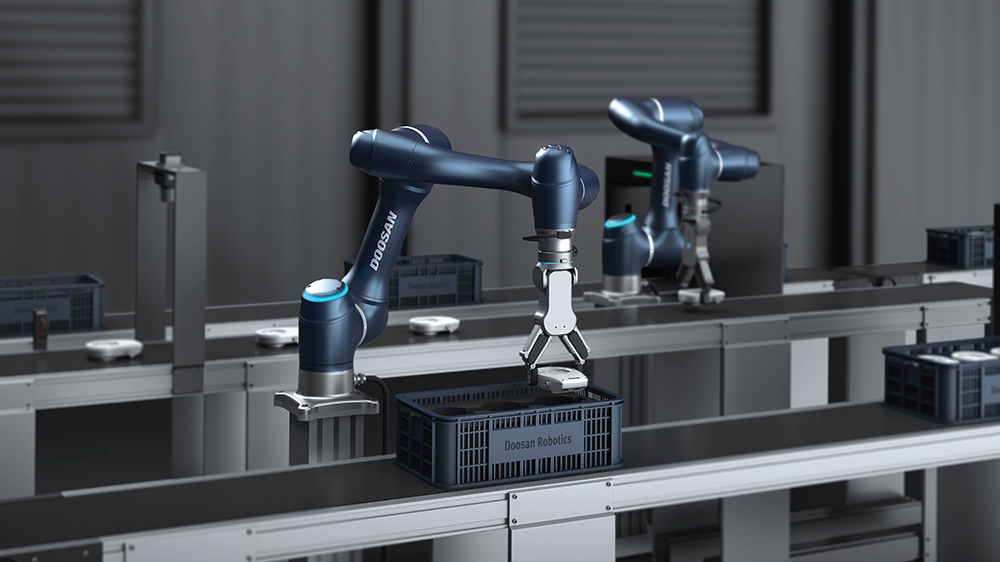
is far more than moving objects from one point to another. It demands high-speed motion that terminates in precisely the right spot — every single cycle. In this environment, repeatability is the core capability that delivers three simultaneous outcomes: faster, more accurate, and more sustained production.
4.1 Direct Cost Reduction
• Defect Reduction and Yield Maximization: Placing components at identical coordinates every cycle eliminates assembly defects at the source. Smart factory quality control is not about filtering defects after the fact — it is
about preventing them from occurring in the first place. Material waste and disposal costs approach zero.
• Workforce Optimization: Skilled operators freed from repetitive tasks can be redeployed to higher-value work — and there is no longer any concern about fatigue-driven turnover.
4.2 Higher Throughput
• 24/7 Uninterrupted Operation: A robot with high repeatability produces the ten-thousandth unit to the same standard as the first — regardless of whether it has been running for one hour or twelve. Uptime above 99% translates
directly to net profit.
• Cycle Time Optimization: Consistent motion eliminates bottlenecks between process stages. Low-repeatability robots must wait for settling vibrations to subside before the next move; high-repeatability robots proceed immediately, maximizing line speed.
• Production Predictability: Unlike human operators whose pace varies with condition, a robot's Units Per Hour (UPH) is fixed to the second. Precise production scheduling becomes possible, eliminating excess inventory and enabling just-in-time material procurement — improving cash flow.
4.3 Maintenance and Operational Efficiency
• Extended Equipment Life: Precise positioning eliminates forced insertions and mechanical collisions, reducing wear on the robot arm, gripper, and surrounding fixtures — and lowering repair costs accordingly.
• Faster Changeover: When a product line changes, the robot returns exactly to its taught coordinates without re-calibration. Shorter change-over times make high-mix, low-volume production economically viable.
4.4 Reliability and Business Competitiveness
• On-Time Delivery: Consistent quality and minimal machine downtime mean delivery commitments are met reliably — a powerful differentiator when competing for contracts with demanding OEMs or international buyers.
• Quality Data as a Business Asset (Traceability): Unlike human error, which is difficult to trace after the fact, every robot action is logged as data. Being able to present customers with a concrete claim — "our facility operates
within ±0.01mm tolerance" — builds sales credibility. As this data accumulates, it supports Smart Factory certification and opens doors to premium-tier contracts.
4.5 ROI: Return on Investment
ROI is the metric executives scrutinize most closely. Analysis shows that pick-and-place robots typically achieve full payback within one to two years, depending on operating conditions. The drivers are straightforward: near-100% uptime generates additional output that flows directly to net income, while the elimination of defect-related losses compounds those savings. The result is a virtuous cycle — producing more, faster, with less waste, around the clock.
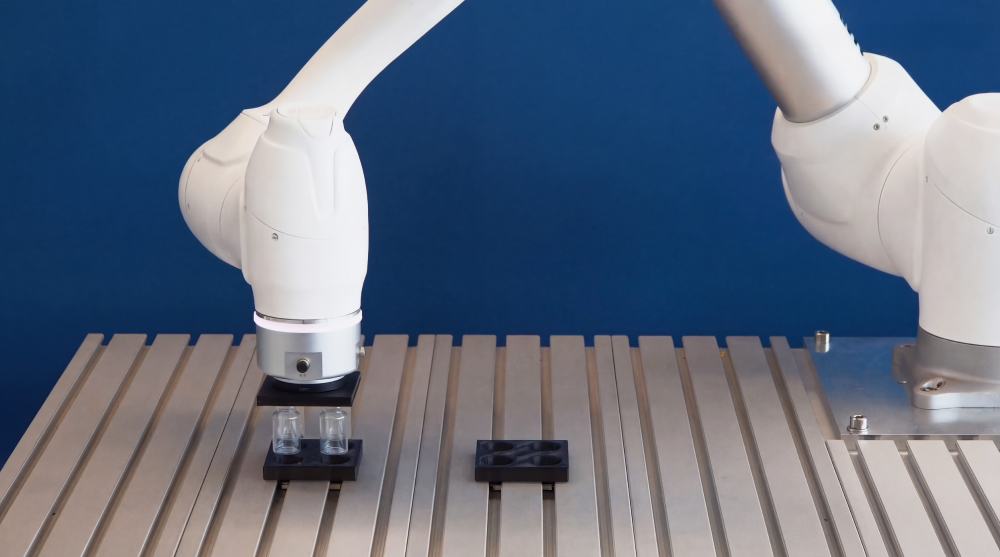
5. Doosan Robotics Collaborative Robot Solutions
Doosan Robotics' collaborative robots embody every technical requirement discussed above. Historically, industrial robots had to be caged behind steel fencing to protect workers. Today, Doosan cobots meet the ISO 9283 international
performance standard, maintain repeatability comparable to traditional industrial robots, and operate safely alongside people in shared workspaces. Beyond positional precision, every joint is equipped with a high-performance torque sensor — enabling a sophisticated layer of force control that ordinary position-based robots cannot offer.
5.1 Repeatability Specifications by Series
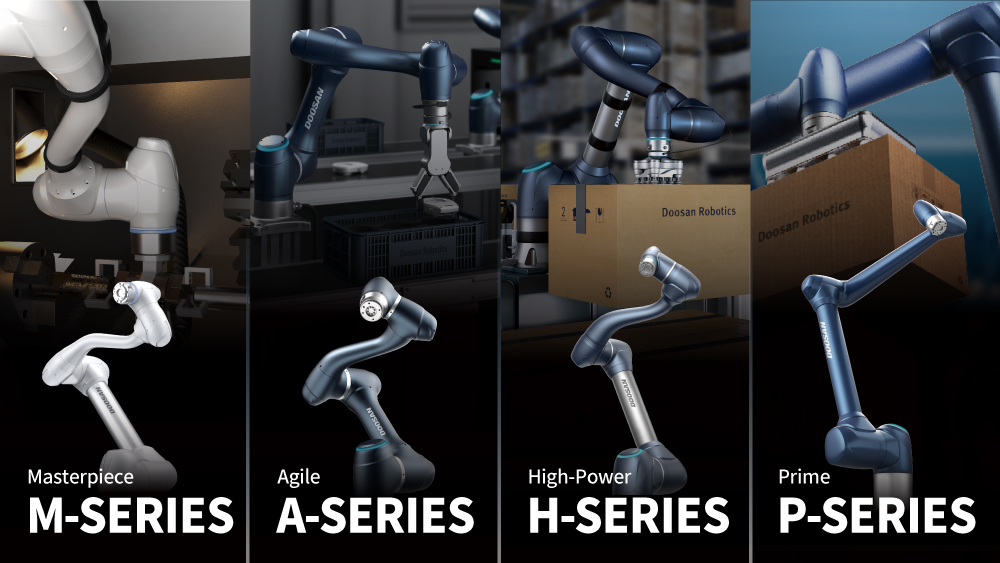
Each series is optimized for a different balance of precision and payload capacity.
• M-Series (Premium): High-performance torque sensors on all six axes. Designed for the most delicate tasks. Repeatability: ±0.03mm (M0609, M1509) ~ ±0.05mm (M0617)
• A-Series (High-Speed / Value): Industry-leading speed and acceleration. Consistent ±0.03mm~ ±0.05mm repeatability across all models.
• H-Series (Heavy Payload): Up to 25kg payload capacity. Maintains stable ±0.1mm repeatability despite the high load.
• P-Series (Palletizing): 30kg payload, 2,030mm reach, ±0.1mm repeatability.
5.2 M0609 — Detailed Specifications
The most precise model in the M-Series, the M0609 delivers consistency at roughly one-third the thickness of a human hair — like an acrobat balancing a heavy load on a tightrope without a single tremor.
• Repeatability: ±0.03mm
• Payload: 6kg
• Reach: 900mm
• Torque sensor sensitivity: detects force changes as small as 0.2N
5.3 Pick-and-Place Application Examples
• Smartphone Box Packaging: Integrated with a vision system to place phone components at defined positions.
• Sheet Metal Handling Automation: Combined with 3D vision to pick irregularly placed metal sheets from a press line and transfer them to the next process — replacing a high-fatigue, avoided task and improving overall efficiency.
• Faucet Assembly: Five M0609 units operating simultaneously to pick and precisely assemble faucet components.
5.4 Space Efficiency — Collaborative Installation Without Fencing
Doosan collaborative robots can be installed directly in an existing workstation — no safety fencing required. The footprint where one operator currently stands is enough space to deploy a robot. Traditional industrial robots require 3–4
pyeong (roughly 10–13 m²) of additional floor space for the robot radius, safety clearance, and steel enclosure. A Doosan cobot operates in under 1 pyeong (approximately 3.3 m²).
• Working Envelope: 900mm reach (radius). Full pick-and-place coverage within approximately 1.8m × 1.8m.
• Actual Footprint: Under 1 pyeong (~3.3 m²) — a revolutionary reduction compared to fenced industrial robots.
• Wall and Ceiling Mounting: When floor space is unavailable, the robot can be mounted inverted on a wall or ceiling, keeping the floor clear as a walkway.
• Mobile AMR Base: Mounted on an AMR (approx. 60cm × 60cm), the robot can work on Line A during the day and be repositioned to Line B overnight.
Conclusion
Figure Doosan Robotics achieves is more than a mechanical specification — it is a guarantee of trust that makes safe human-robot coexistence possible. Repeatability is not simply a machine parameter. It is the defining measure of process reliability, product quality, and business competitiveness.
Doosan Robotics' collaborative robots deliver ±0.01mm top repeatability and torque-sensor-based force control in a compact, fence-free package that can be deployed immediately. In the automation landscape ahead, precision will be the decisive competitive advantage. Build your future on a foundation that never wavers.
"Produce more, faster, around the clock — with no quality concerns and lower costs." That virtuous cycle on the manufacturing floor begins with repeatability.
📞 Want to find the right robot solution for your production process?
Doosan Robotics experts are available for on-site consultations and live demonstrations.
Click here to request a consultation.
