

Kwangjin Achieves Near-Zero Defects with Doosan Cobots
2026. 06. 26
“We Don’t Use Chinese-Made Robots, Even If They’re Cheaper”… Doosan Collaborative Robots Become ‘Factory Aces’ as Defects Near Zero
Source: MoneyToday (Original article: https://www.mt.co.kr/industry/2026/06/26/2026062517001050048)
Reported by Hanna Park, Sunil Yoo and Chan-young Lim
June 26, 2026
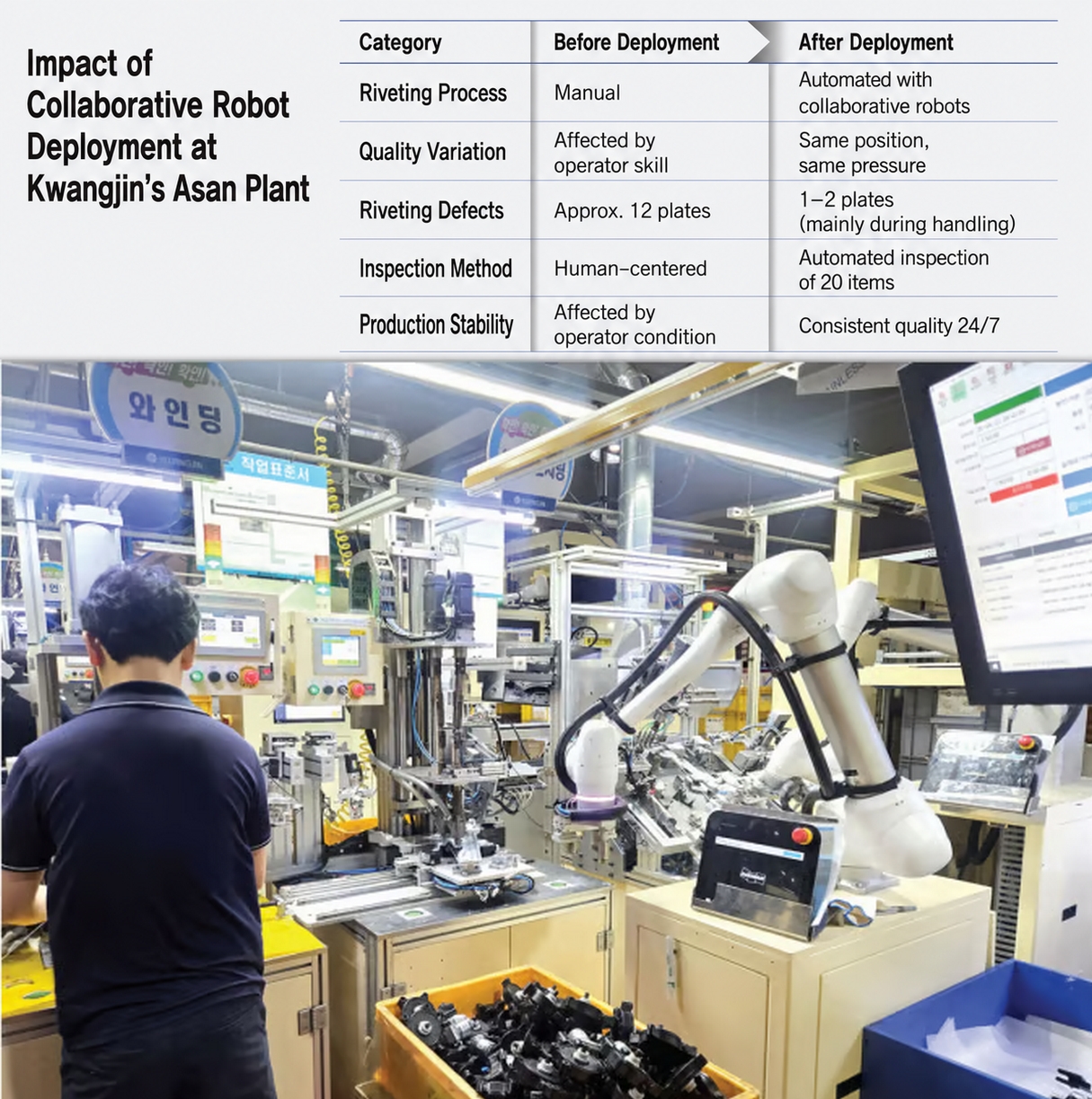
Korea’s robotics competitiveness, widely regarded as among the strongest in the world, has been built on active adoption across manufacturing sites. According to the International Federation of Robotics (IFR), Korea ranks first globally in manufacturing robot density. Manufacturers’ accumulated operational experience has supported technological improvements by robotics companies, and those advances are then applied back to industrial sites in a reinforcing cycle.
Kwangjin Group (Kwangjin), an automotive-parts manufacturer, offers a representative example of this Korean robotics ecosystem at its Asan plant in South Chungcheong Province.
During a visit to the Kwangjin Asan plant on June 8, four Doosan Robotics collaborative robots were continuously lifting black module plates weighing 1.1 kg each. After positioning the plate precisely over a pulley, a key component of an automotive window regulator, the robots placed a small metal ring, or washer, at the joint and applied strong pressure to secure the component.
The door-module riveting process—previously dependent on the fine touch and consistency of human operators—had been replaced by repeatable robotic movements. A door module is an integrated automotive-door assembly in which functional components, including a window regulator, speakers and a door latch, are installed on a module plate that serves as the structural backbone inside the vehicle door.
In the past, operators manually inserted washers one by one. The issue was that it was difficult for people to apply the same amount of force at exactly the same position every time. If pressure was applied before even one washer was properly seated, the entire module plate had to be discarded. While Kwangjin had managed its defect rate below 100 PPM, or 100 defective units per million, its riveting process across six module lines still produced roughly 12 defective plates.
That has changed significantly. Since deploying Doosan Robotics collaborative robots together with vision inspection, defects in the riveting process have fallen to just one or two plates—effectively approaching zero. A single Doosan Robotics collaborative robot repeatedly lifts module plates weighing 1.1 kg and finished products weighing up to 3.5 kg around 4,000 times, while maintaining the same position and pressure throughout the process.
This has virtually eliminated variation caused by differences in worker skill levels or physical condition. Most remaining defects are now caused by impact or drops during transfer and handling, rather than by the manufacturing process itself.
The collaborative robots also inspect 20 components across 14 vehicle models and configurations. The inspection covers window-regulator operation, proper upward and downward movement, operating speed, motor load, missing parts and wire-assembly defects. When an abnormality is detected, the unit is immediately diverted to a separate line, preventing it from moving on to subsequent processes or reaching customers.
“Quality control is more important than production volume in automotive-parts manufacturing,” said Siwon Kim, Director, Kwangjin Machinery Production Team. “A single defective part can require a full inspection of the entire line. Today, however, manufacturing-process defects have almost disappeared.”
Kwangjin’s adoption of collaborative robots began with its first meeting with Doosan Robotics in 2024. At the time, labor shortages had made further automation unavoidable. Doosan Robotics introduced multiple collaborative-robot applications in Korean manufacturing and demonstrated the need for automation.
After carefully reviewing the expected return on investment and payback period, Kwangjin invested approximately KRW 1.3 billion and implemented collaborative robots on active mass-production lines over a period of roughly four to six months.
“We also compared Chinese-made robots during the review process,” Kim said. “They were price competitive, but their domestic after-sales support infrastructure was limited, and we determined that immediate response would be difficult if an issue occurred. Doosan Robotics was the most suitable choice because its dedicated engineer support and technical-response systems are well established compared with both domestic and overseas suppliers.”
Kwangjin’s collaborative-robot automation has since become a benchmark for other manufacturers. Korean automotive OEMs are visiting the Asan plant to observe 19 Doosan Robotics M-SERIES collaborative robots operating in the facility. The robots offer a 1,300 mm reach and a maximum payload of 10 kg.
Kwangjin plans to sequentially deploy more than 100 collaborative robots across 17 global sites, including facilities in the United States and Poland, by 2027. Its U.S. plants are also pursuing plans to apply Doosan Robotics collaborative robots to all newly established production lines beginning in 2027.
Doosan Robotics plans to expand its intelligent robotic solutions by combining AI, vision and motion-control technologies with collaborative-robot technologies already proven in manufacturing environments. As demonstrated by the Kwangjin case, the company’s focus is on providing robot solutions that can be deployed immediately at real production sites, including existing mass-production equipment.
Looking ahead, Doosan Robotics aims to build on these AI-based intelligent robotic solutions and expand into Industrial Humanoid technology capable of performing skilled-worker-level tasks end to end across a range of industries.
Doosan Robotics is also developing an agentic robot operating system using NVIDIA Isaac Sim and related technologies. The operating system is designed to handle perception, reasoning and simulation, enabling robots to independently recognize their work environment, make decisions and operate autonomously.
Through these efforts, Doosan Robotics plans to strengthen its competitiveness in both intelligent robotic solutions and Industrial Humanoid technology.
“It is particularly meaningful that Doosan’s robot solutions are being deployed in automotive-parts manufacturing environments, where rigorous quality standards and stable production capabilities are essential,” said Hyunsoo Kim, Vice President of Sales, Doosan Robotics. “Building on results proven at Korean production sites, we will continue working with Kwangjin Group to ensure that these solutions can be reliably deployed at its overseas manufacturing bases, including in the United States.”
