

Optimizing Just-in-Time Manufacturing with Collaborative Robotics
2025. 10. 24
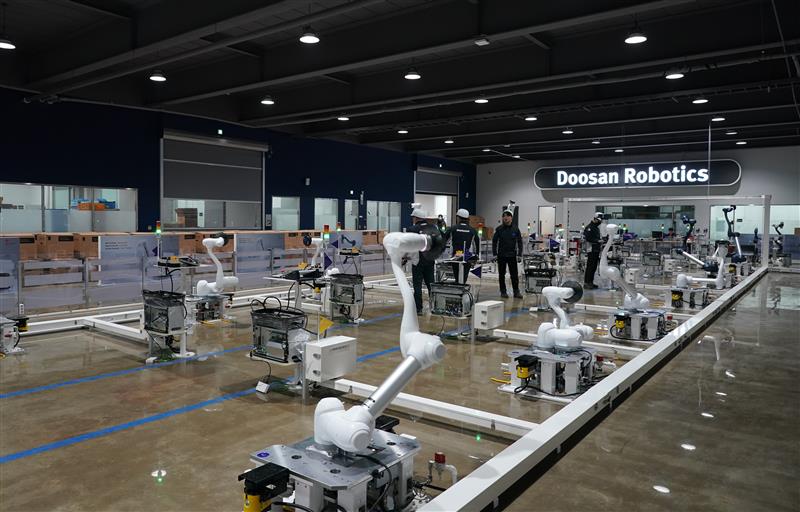
Learn how cobots enhance just-in-time manufacturing with speed, flexibility, and adaptable automation that reduces waste and improves output.
Why JIT Needs Flexible Automation
JIT succeeds when operations flow without delays or buffer inventory. Manual processes introduce variation and limit
speed. Collaborative robots work alongside operators, handling repetitive tasks at consistent cycle times while humans
manage quality oversight and complex decisions.
Link: Inquire about automation robots at Doosan Robotics
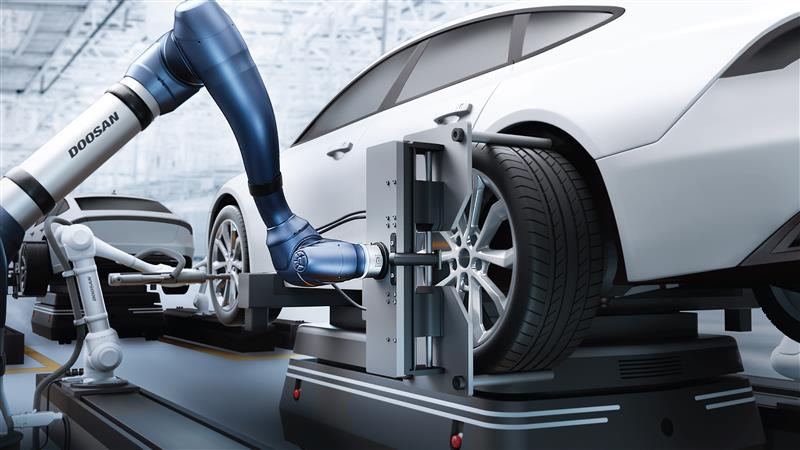
Assembly: Speed Meets Precision
Screw driving
Collaborative robots apply exact torque on every fastener, completing sequences like manual work. Product changeovers take
15-20 minutes instead of days of retraining.
Component insertion
Force-sensing technology ensures proper seating and rejects defects in real-time. A 6kg payload cobot handles most
assemblies with ±0.0mm repeatability— achieving precision comparable to that achieved by hand.
Link: Learn more Assembly Applications
Material Handling: Eliminating Waste
Workstation transfer
Collaborative robots move parts between operations continuously, eliminating 2-3 minute manual delays that kill capacity.
Consistent timing stabilizes takt time across production lines.
Palletizing
Robots stack finished goods at 8-12 cycles per minute without fatigue, optimizing container utilization and reducing
shipping damage.
Bin picking
Vision-guided collaborative robots retrieve randomly oriented parts and feed them correctly oriented, eliminating sorting
bottlenecks.
Link: Learn more Material Handling
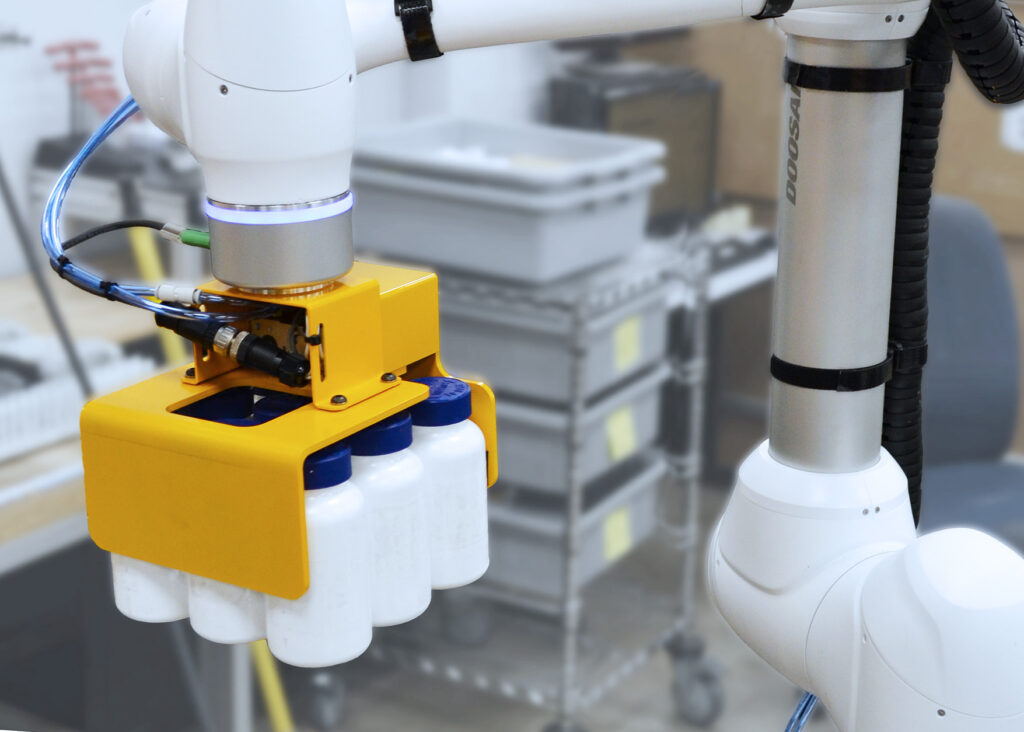
Machine Tending: Maximum Utilization
CNC operations
A 10kg robot loads material and removes parts without interruption, recovering 30-40 minutes of capacity per shift per
machine. The idle time between manual cycles simply disappears.
Injection molding
Immediate part removal enables faster cycles. The robot can insert components or inspect parts while the next piece
cures—parallel processing manual work cannot achieve.
Stamping
Collaborative robots handle hot, noisy metal forming operations at consistent speeds, improving safety and throughput
simultaneously.
Link: Learn more Machine Tending
Surface Finishing: Consistent Quality
Sandin
Collaborative robots complete sanding 2-3x faster than manual methods when accounting for eliminated rework. They operate
at 100% efficiency continuously while manual productivity drops 25-30% per shift due to fatigue.
Deburrin
Consistent pressure and exact edge-following make cycle times predictable with uniform quality across all parts.
Polishin
Force control maintains precise contact on complex contours, producing finish quality manual operations struggle to match
in high-volume runs.
Link: Learn more Surface Finishing
Quality Inspection: Inline Speed
Vision-equipped collaborative robots measure dimensions against CAD specs in real-time, rejecting non-conforming parts
before they advance. Cameras detect surface defects manual inspection misses during repetitive production. Automated
functional testing verifies performance while collecting data for continuous improvement.
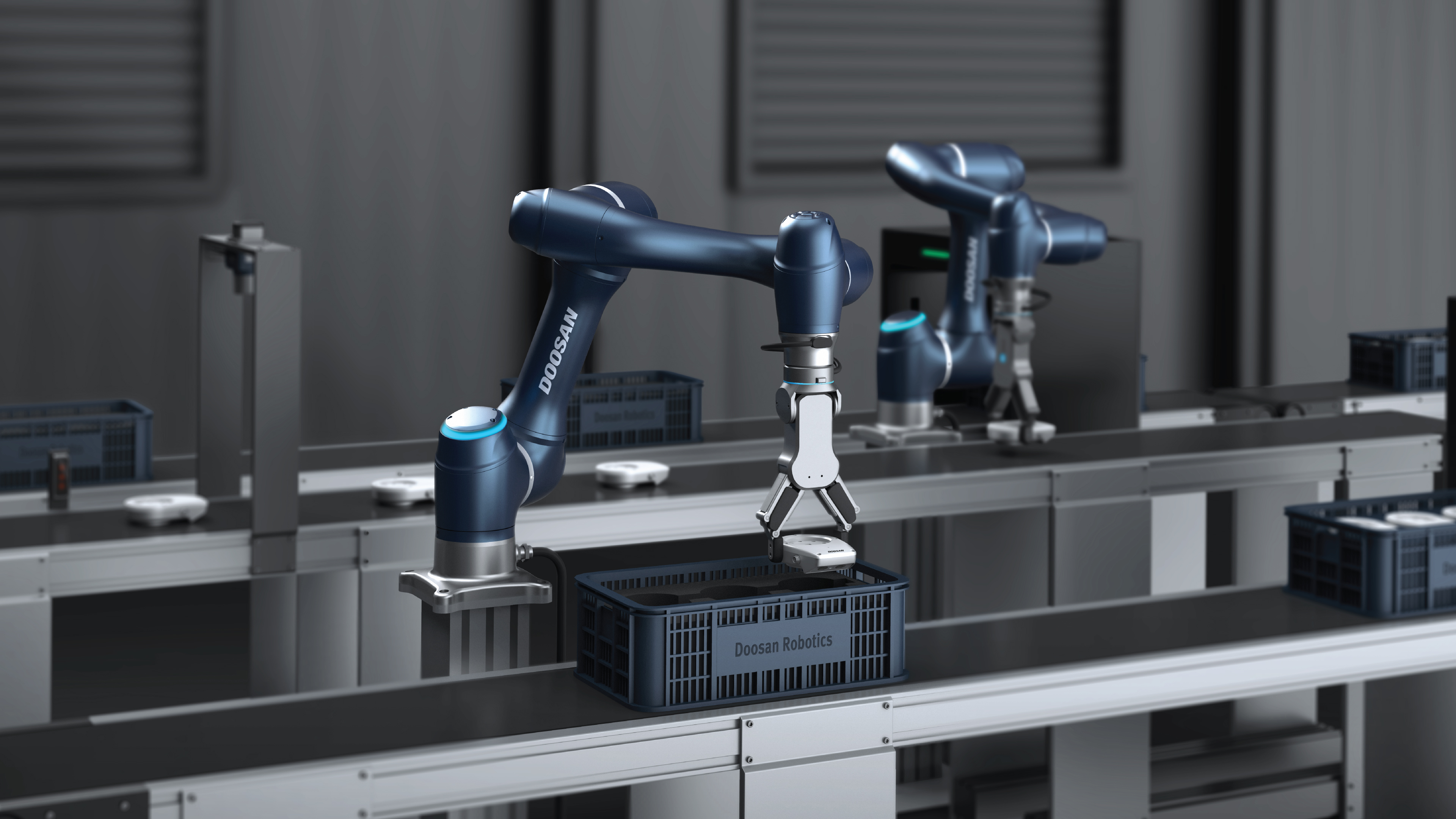
Real ROI Numbers
Throughput
Increasing production capacity during the same period eliminates the need for employee overtime and the purchase of
additional equipment.
Quality
By reducing defect rates, these savings can be redirected to production or material purchases.
Inventory
A more predictable production cycle allows for less unnecessary inventory, allowing for more efficient and more flexible
use of operating costs.
Payback
Effectively addressing bottlenecks in the production process can result in a payback of 12 to 18 months.
Doosan Robotics Solutions
P-SERIES
30kg payload for palletizing and heavy item handling.
H-SERIES
25kg payload for heavy-duty machine tending.
M-SERIES
6-15kg payload for assembly and material handling.
A-SERIES
±0.02mm repeatability for ultra-precise applications.
All models feature force-torque sensing, intuitive programming, and compact footprints that integrate without facility
modifications. Collaborative operation means robots work directly alongside humans.
Start Smart
Pick your biggest bottleneck—the operation forcing buffer inventory or overtime. That's your first application. Prove ROI,
build expertise, then expand. Operators who can program robots become your competitive advantage.
JIT manufacturing eliminates waste while maintaining flexibility. Collaborative robotics provides automation that adapts
as fast as production needs change. The technology exists. The applications are proven. The advantage belongs to
manufacturers who act decisively.
Link: Inquire about automation robots at Doosan Robotics
